
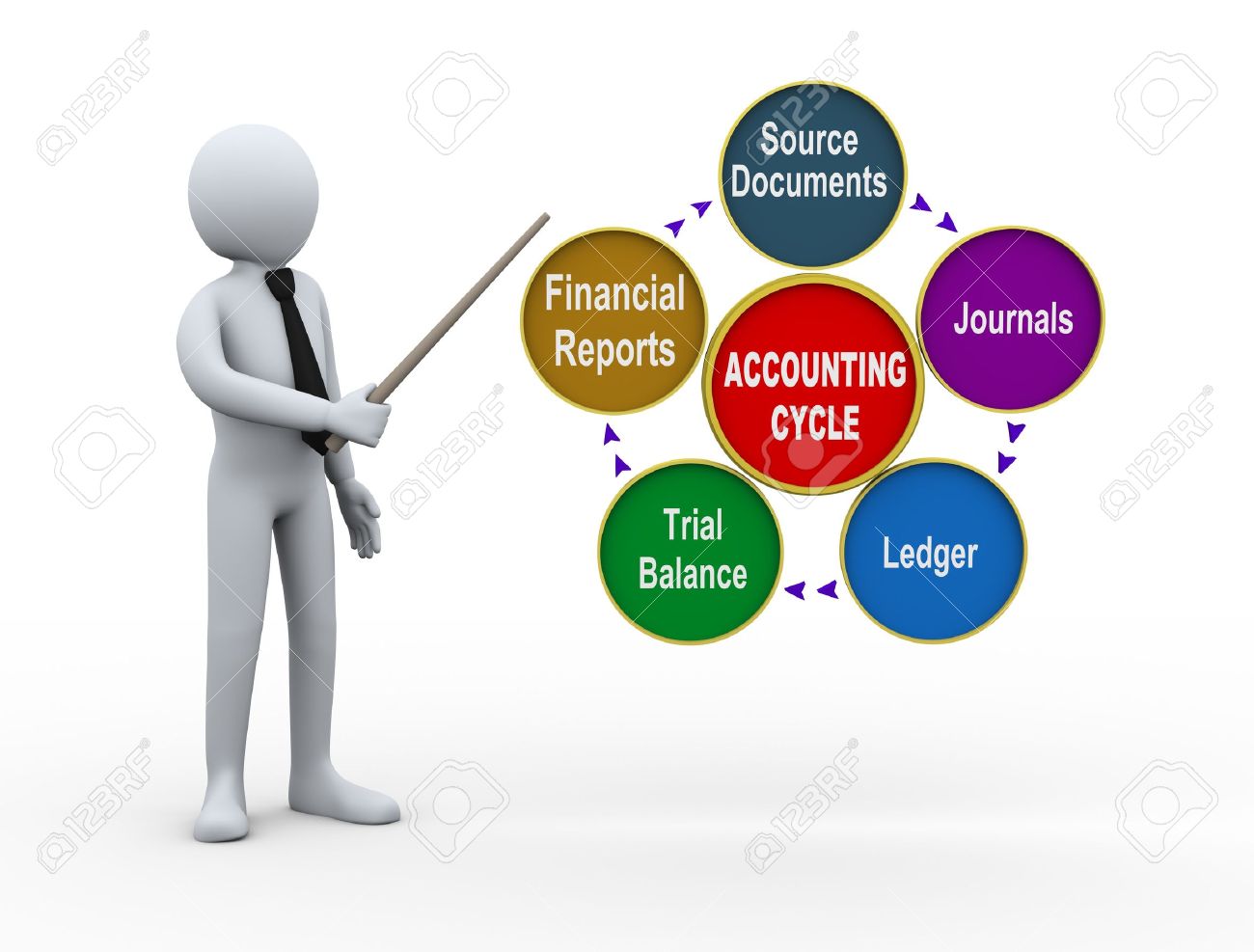
Accounting Cycle by Definition
Accounting cycle is a systematic, orderly identification, analytical arrangement and recording of financial or accounting events of an organization. In simple terms, accounting cycle occurs in a daily step by step financial transaction or decision in an organization. Accounting circle begins with transaction occurring, transaction analyzed, entered in the journal, and posted to the ledgers. It is then transferred to trial balance, adjusted if required before producing financial statement.
Accounting Rules
In accounting, there are guidelines that must be followed as stated in the International Financial Reporting Standard (IFRS). These guidelines developed by International Accounting Standards Board (IASB) and adopted by most countries around the world. One of the reasons for standards is uniformity across board. The rules of debit and credit is better understood using ‘DEALCLIP’. This means to Debit Expenses, Assets, Losses and Credit all Liabilities, Income and Provisions. In accounting cycle, the law of debit the receiver and credit the giver also comes to play always. This means whoever gives is recognized and appreciated (credited). As such, the one receiving will receive no appreciation (debited). Another very important rule is to always record a debit transaction first, then credit transaction next.
Finally, for every debit, there is always a corresponding credit; never forget! This means, at least two entry must occur.
The Journal
Firstly, the accounting cycle begins with data sourcing. It inputs data into a journal. In accounting cycle, a journal records all financial transaction of a company in a chronological order as it happens. This is called a journal. A journal identifies date, description, amount, particulars, and account. Journalizing process follows three steps: Specify each account affected by the transaction. Classify each account by type (asset, liability, stockholders’ equity, revenue, or expense). Determine increased or decreased in transaction. Then, use rules of debit and credit to increase or decrease each account. Record the transaction in the journal by including a brief explanation. The debit side is entered on the left margin, and credit side is indented to the right. A transaction must have a debit and credit entry always. At times, it may have more than two entries. Regardless, accounting circle follows the pattern listed in this write up.
The Ledger
Ledger is a book of account to record, store and document accounting transaction. They are bookkeeping entries mostly used for income statement and statement of financial position at a point in time. Accounting ledger can include cash, account payable, accrued expenses, account receivable, inventories etc. Accounting ledger contains date, particulars, debit, credit, and balance. They are ‘T’ like entries, treating accounts uniquely. Ledger helps to track and manage financials especially operations.
Trial Balance and Adjusted Trial Balance
The next on accounting cycle is the trial balance. A Trial Balance lists all accounts with their balances at a given point in time. It tests arithmetical accuracy of accounting entries. The trial balance summarizes all the account balances and shows whether total debits equal total credits. The aim of trial balance is to ensure financials in the journal and ledger aligns. When the total does not align in trial balance, it denotes that account is not balance. As a result of unbalanced account, there is provision for adjusted trial balance. Trial balance shows the organization’s true financial stand at a point in time. Adjustment is made by returning to data sourcing to identify discrepancies. Afterwards, update the account with notes.
More on Adjusted Trial Balance
The adjusted balance sheet gives more information in notes. It helps understand the true picture causing adjustment. So, it helps show correct entries. The adjusted trial balance is the last stage before preparing financial statement. The financial statement is useful for internal and external purpose, it is hence important to do all checks and balance thoroughly. The government, shareholders, stakeholders, management, potential investors are users of financial statement. This means, it must at all times show a true reflection of the financials. It is punishable by law to give false financials to the public.
In Conclusion
The above shows processes in accounting cycle. It shows the importance of source data because no account can happen without data sourcing. Every part in accounting cycle is key, relevant, and interwoven. The accounting cycle is the life of all financial statement; it shows clarity, it portrays a true picture of events in an organization and useful for a full accounting period. Organization’s documentation is important always. These documents are the sourced data for financial statement processes. The accounting cycle births financial statement. The financial statement shows a true picture of the organization in monetary terms.

 Questionable Payment.