
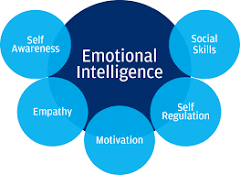
Your success depends more on your emotional quotient than your intelligence quotient. Your technical ability can give you a job, but your character will sustain you on the job. You need to control your emotions before you can relate well to society.
The following are the significant traits of intrapersonal emotional quotients: Patience, ability to control impulsive behaviour, delayed gratification, stress management, anxiety, excitement etc. A passion for succeeding despite the challenges, optimism in the face of failure, a high-stress tolerance, calm under pressure, a high ethical outlook, assertiveness, internal locus of control, take responsibility.
The following are the significant traits of interpersonal emotional quotients: Non-judgemental, effective communication, attentiveness, excellent listening skills, responsiveness, the capacity to commit to people and causes(building social capital), open, fair and flexible, approachable, high stress tolerant, calm under pressure, empathy.
The following are signs of low IQ: Stress, depression, anger management, easily irritability, prone to violence, external locus of control, lack of self-control, eating disorder, drug abuse, and incivility.
How do you increase your emotional intelligence? You can explore the following tips:
- Keep your stress under control: Low and high stress isn’t ideal for any human. You should endeavour to maintain optimum performance in managing stress. Low-stress results in boredom or increased attention or interest. Have you ever felt restless before? That could be low stress. High pressure leads to intense anxiety or a complete meltdown. Worrying regularly is a strong indicator of stress.
- Get more sleep: You shouldn’t just sleep but have a sleep routine. Researchers recommend that you rest for between 7-8 hours every day. Before sleeping, shut down all your electronic gadgets, including TV, laptops and phones. The lighting produced by these electronics distorts the quality of your sleep.
- Sports and exercise: Sports and exercise relax your muscle and make you fit. Exercising also make you smarter and makes your thought to be precise.
- Manage your anger: Managing anger is very important in maintaining interpersonal relationships. Anger has destroyed the best of the relationships, lives and properties. You can do the following to manage your anger: 1. Keep quiet when angry. 2. Practice impulse control 3. Smile 4. Take a deep breath 5. Count up to 10 –100 6. Meditate 7. Sing a song 8. Walk away 9—exercise 10. Think of something funny 11. Play your favourite music 12. Think of the essential things in your life. 13. Think of the likely consequences of your actions and what you might lose.
- Emotional agility: “Being flexible with your thoughts and feelings so that you can respond optimally to everyday situations.” –Susan David. It is staying true to your deep values and pursuing your biggest long-term goals despite the challenges and setbacks. For Emotionally agile people, every day is a bright sunshiny day!
- Effective communication: Listen; pay attention to Body Language. Be open to others’ ideas and perspectives.
- Gratitude: Gratitude can transform typical days into thanksgivings, turn routine jobs into joy, and change ordinary opportunities into blessings.” —William Arthur Ward. “Acknowledging the good you already have in your life is the foundation of all abundance”- Hechart Tolle

 What is the Buzz about Waterfront properties?