
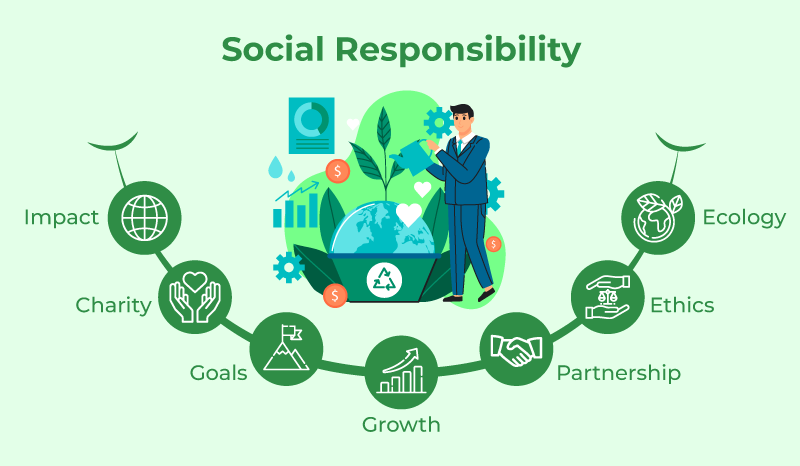
From organization to organization, “socially responsible” is defined differently. The triple bottom line, which states that a corporation should be devoted to monitoring its social and environmental effect, sustainability efforts, and earnings, serves as a common framework for businesses. The motivating cause for the triple bottom line is frequently summed up by the proverb “Profit, People, Planet.”
TYPES OF CORPORATE SOCIAL RESPONSIBILITY
Responsibility to the environment
Environmental responsibility is the idea that businesses should act in a way that is as ecologically beneficial as feasible. One of the most widespread examples of corporate social responsibility is this. Some businesses refer to these programs as “environmental stewardship.”
There are numerous ways for businesses to embrace environmental responsibility: lowering water use, pollution, greenhouse gas emissions, use of single-use plastics, and trash in general increasing reliance on sustainable resources, recycled materials, and renewable energy sources to control energy usage reducing harmful environmental effects, such as by sponsoring research, planting trees, and making donations to organizations that support similar causes.
Moral Responsibilities
Making sure a company runs ethically and fairly is part of having ethical responsibility. When an organization embraces ethical responsibility, it aspires to act ethically by treating all parties fairly, including the leadership, investors, employees, suppliers, and customers.
There are numerous ways for businesses to embrace ethical responsibility. For instance, if the minimum wage set by the state or federal government is not a “livable pay,” a business may set its own, higher minimum wage. A company may also demand that goods, ingredients, supplies, or parts be sourced in accordance with free trade principles. Many businesses have procedures in place to make sure they aren’t purchasing goods made using child labour or slavery in this area.
The Duty of Philanthropy
A company’s desire to actively improve society and the globe is referred to as having philanthropic duty. Organizations with a philanthropic focus frequently donate a portion of their profits in addition to operating as morally and environmentally responsible as they can. While many businesses give to organizations and charities that share their guiding principles, others make donations to deserving causes that have little or nothing to do with their line of work. Some people even go as far as to start their own foundation or charitable trust in order to give back and improve society.
Economic Responsibilities
Economic responsibility is the practice of a company committing to do good in the aforementioned areas while supporting all of its financial decisions. The ultimate objective is to ensure that corporate operations have a good influence on the environment, people, and society, not just to increase profits.
Moral convictions are the main reason why most businesses adopt corporate social responsibility, which has a number of advantages and can significantly impact society. Initiatives in support of corporate social responsibility, for instance, can be effective marketing strategies that assist a business gain favor with customers, shareholders, and regulators. CSR programs can also increase employee satisfaction and engagement, two crucial factors in retention. Such programs may even draw job candidates with strong personal convictions that align with those of the company.
Finally, corporate social responsibility initiatives, by their very nature, force business leaders to review practices related to hiring and managing employees, sourcing products or components, and delivering value to customers. This reflection can often lead to innovative and pioneering solutions that help businesses become more socially responsible and increase profits.
