
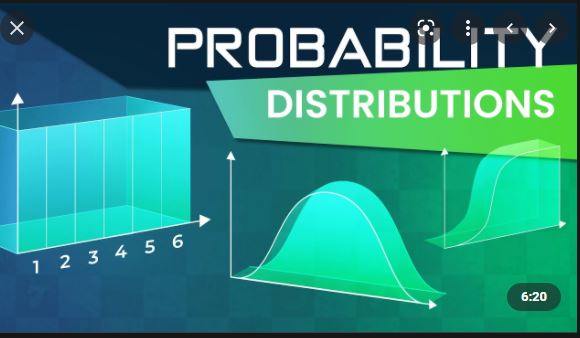
The probability distribution for a random variable describes how the probabilities are distributed over the values of the random variable. For a discrete random variable, x, the probability distribution is defined by a probability mass function, denoted by f(x). This function provides the probability for each value of the random variable. In the development of the probability function for a discrete random variable, two conditions must be satisfied: (1) f(x) must be non-negative for each value of the random variable, and (2) the sum of the probabilities for each value of the random variable must equal one.
A random variable is a numerical description of the outcome of an experiment.
A discrete random variable may assume either a finite number of values or an infinite sequence of values.
A continuous random variable may assume any numerical value in an interval or collection of intervals.
Dr. Bongo did justice to the above topic with practicality approach to teaching. He patiently carries us along. He teaches with passion and ability for us to understand and able to apply the phenomenon whenever required. At Lagos business school, the course “data analytics” of which probability distribution, one of the topics in the course is taught with the students practicing examples in the class with the guidance of the lecturer.
The use of excel application software in computing data analytics problem is commendable. We use excel to solve all of our probability problems. Before now, I use to know that we solve most of our statistical problems by mathematical calculations. The use of excel makes it very simple and systematic. Probability distribution seeks to solve the problem of decision making in an organization. Data gathering and proper data storage is essential for organizations who intend to understand and identify the cause of a problem and ability to solve such problems.
Decision making requires number crunching and scoping of all data points in an organization. Probability distribution requires the use of random sampling. You are said to be rational when you take a decision that benefits you.
The Benefits of Probability Distribution in Management Decisions.
Scenario Analysis. Probability distributions can be used to create scenario analyses. For example, a business might create three scenarios: worst-case, normal and best-case. The worst-case scenario would contain some value from the lower end of the probability distribution; the normal scenario would have a value towards the middle of the distribution; and the best-case scenario would contain a value in the upper end of the scenario.
Sales Forecasting. One practical use for probability distributions and scenario analysis in business is to predict future levels of sales. It is essentially impossible to predict the precise value of a future sales level; however, businesses still need to be able to plan for future events. Using a scenario analysis based on a probability distribution can help a company frame its possible future values in terms of a normal sales level and a worst-case and best-case scenario.
Risk Evaluation. In addition to predicting future sales levels, probability distribution can be a useful tool for evaluating risk. Consider, for example, a company considering entering a new business line. If the company needs to generate $100,000 in revenue in order to break even and their probability distribution tells them that there is a 20 percent chance that revenues will be less than $100,000, the company knows roughly what level of risk it is facing if it decides to pursue that new business line.
#EMBA27
