
As the world grapples with the issues associated with climate change occasioned by the years of irresponsible handling of the environment in favor of industrialization and urbanization, it is now the task of all and sundry to ensure that this does not become the beginning of the end for humanity.
As we continue the journey towards creating a more sustainable planet not just for ourselves but to hand over to the next and coming generations, it becomes imperative that we explore ways to create climate resiliency amidst the challenges as a way out, and this entails a structured analysis to proffer solutions for the problem.
Nigeria among the global committee of nations; is not immune to the challenges of climate change and must rise to the occasion by adopting the most appropriate and bespoke solutions to solve its problems.
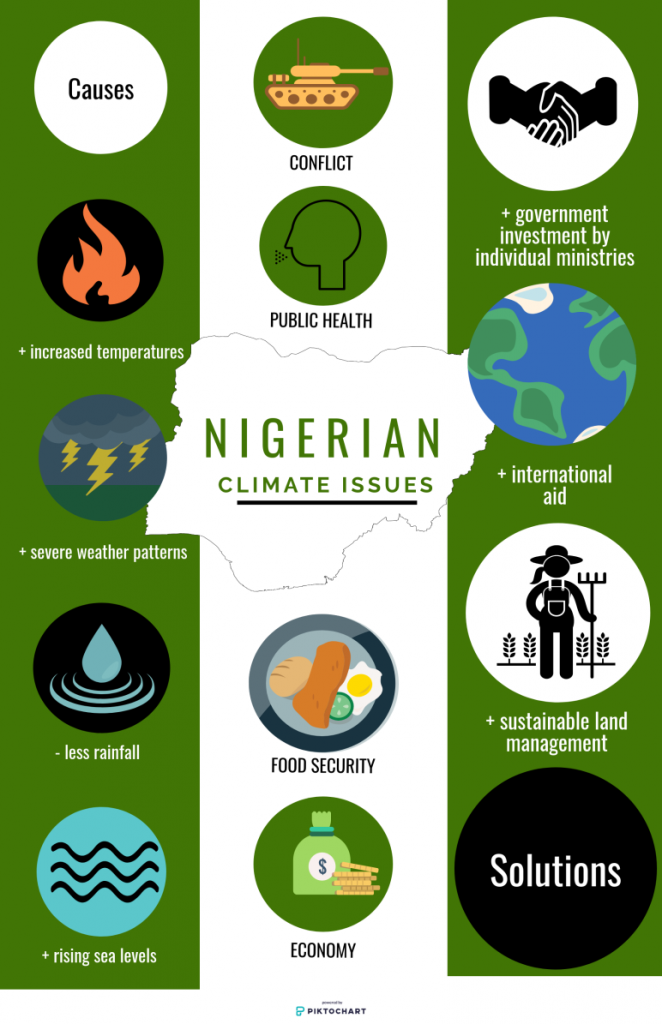
Nigeria’s challenge is multifaceted for several reasons. The first is the issue of population growth which has been almost near-exponential over the past few decades as the population is expected to continue to grow to 400 million within the next 50 years. Over the years, this has seen a swell in the urban populations, leading to drainage issues and gully erosion development due to increased land use modifications, poor agricultural practices, incomplete infrastructure such as roads without drainages, and poor town and regional planning practices. The coastal and riverine communities have also witnessed over the recent years, a significant rise in coastal and riverbank erosion occasioned by rising water levels and overflowing riverbanks. The effects have been very devastating, farmlands rendered unusable, and flora and fauna lost in a wave of ecological degradation.
According to statistics, Nigeria is the third most ecologically challenged country on the planet behind China and India whereas it has limited access to climate change financing despite its dire situation. This can be attributed to its very haphazard and unclear strategic framework for combating the climate question over the years.
The first and foremost step to resolving this quagmire requires the articulation of a clear objective addressing the reversal of this trend. For this, the country must engage with a comprehensive think tank of all relevant stakeholders from both Government, Corporate Organizations, Civil Society, and the citizenry to adopt an inclusive strategy towards climate resilience and sustainability.
Part of the factors that have worked against most of the historical climate change initiatives has been the absence of a realistic and encompassing strategy and this is due to a disconnect between plans and their implementation.
For a start, a clear problem definition outlining the challenges in its most simplistic and identifiable form for easy scoping and understanding by all stakeholders must be immediately conceptualised.
Further to this, multiple alternative courses of action would have been up for consideration, and these should consider the technology to adopt, the geographical conditions as well and the time perspective.
With a clear objective in place, a criteria-based analysis of the various alternative measures will be adopted, weighing each of the alternatives based on the scale of importance, context, and impact.
With the considerations of the alternatives on a weighted-based criteria analysis, it is decision time and while this is by no means easy, it is most necessary to put all the outputs of the thought process together.
The final decision should be the most optimal in terms of cost, methodology, and impact and should have minimal impact on the livelihood of the communities involved with the quickest or shortest deployment timescale.
Once the decision has been agreed upon, a series of action plans will be immediately drafted for implementation and this should include short-term, medium-term, and long-term measures that address the immediate and other wider-scale issues.
Simple measures such as methodologies on waste disposal, bush burning, or agricultural and green infrastructural development practices can go a long way in closing the gaps identified in the problem statement and the criteria-based analysis.
It is expected that there will be risks associated with the decision, and to nullify or avert their materialization, a risk mitigation plan would have to be instituted and reviewed on a short to long-term basis.
Lastly, the plan should be evaluated and monitored on a consistent basis to ensure effectiveness and feedback should be regularly sought from the stakeholders to continue to improve on the various systems.
A well-structured and encompassing climate resiliency framework is a sure step to help the country address the issues of climate change in a manner that optimizes resources and involves the most suitable technological measures as well as accessing support and finance to resolve this challenge from the global pool of resources.