
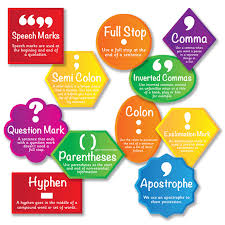
Punctuation marks may seem like minor details in the world of language, but they play a significant role in making our written communication clear, meaningful, and effective. These seemingly small marks serve as the traffic signals of language, guiding the flow of words, providing context, and ensuring that your message is understood as intended. Let’s take a closer look at the use of punctuation marks and their importance in written communication.
1. Period (.): The humble period serves as a full stop, indicating the end of a sentence. It separates distinct thoughts and gives readers a moment to breathe. Without periods, text would be an unreadable jumble.
2. Comma (,): Commas are versatile workhorses. They separate items in a list, create pauses in a sentence, and clarify the relationships between words. For example, “Let’s eat, Grandma” versus “Let’s eat Grandma” illustrates the life-saving power of a comma.
3. Question Mark (?): This mark signifies a question and invites a response. It turns a statement into an inquiry, allowing us to seek information and engage in meaningful conversations. Without it, questions would be confusing.
4. Exclamation Mark (!): Exclamation marks express strong emotions or excitement. They add energy and enthusiasm to a sentence, but excessive use can dilute their impact. “I won!” conveys jubilation, while “I won.” seems lackluster.
5. Quotation Marks (” “): Quotation marks enclose spoken or written dialogue, distinguishing it from the surrounding text. They ensure that readers know who is speaking and when someone is quoting another source.
6. Colon (:): Colons introduce lists, explanations, or summaries. They serve as signposts, guiding readers to what comes next. “There are three reasons for this: first, second, and third” clearly outlines the structure.
7. Semicolon (;): Semicolons link closely related ideas within a sentence. They demonstrate a connection stronger than a comma but gentler than a period. Semicolons add depth to writing by showcasing relationships between thoughts.
8. Dash (—): Dashes can emphasize or interrupt a thought. They add drama and indicate an abrupt change or shift in the narrative, often for emphasis or surprise.
9. Apostrophe (‘): Apostrophes signify possession or contraction. They help clarify meaning and prevent confusion, as in “It’s” (contraction of “it is”) and “Its” (possessive form).
10. Hyphen (-): Hyphens connect words or parts of words. They eliminate ambiguity, as in “re-examine,” where the hyphen indicates the need to examine something again.
Punctuation marks serve several important purposes in writing:
1. Clarity: Punctuation helps to clarify the meaning of a sentence. It indicates where sentences begin and end, and it separates ideas within a sentence.
2. Readability: Punctuation makes text more readable. This aids comprehension and prevents run-on sentences.
3. Emphasis: Punctuation can be used to emphasize certain words or phrases, drawing the reader’s attention to key points.
4. Tone and Mood: Punctuation can convey the tone and mood of a piece of writing.
5. Organization: Punctuation helps in organizing ideas. Lists, for instance, are made clear by commas or semicolons.
6. Quoting: Quotation marks are essential for indicating spoken or cited words, making it clear when someone is being quoted.
7. Questions and Exclamations: Question marks and exclamation points denote questions and exclamations, respectively, adding depth to written expression.
8. Conciseness: Proper punctuation can often make a sentence more concise and precise.
9. Grammar and Syntax: Punctuation is crucial for maintaining correct grammar and structure of statements in a language.
Punctuation is not just an arbitrary set of symbols; it’s the foundation of effective written communication. Proper use of these marks ensures that your message is understood, conveys the right tone, and enhances the readability of your text. So, whether you’re writing an academic essay, a casual email, or a social media post, remember that punctuation is the silent hero that brings clarity to your words.
Adetoun Akingbojule MEMBA12

 The call for self-care #MEMBA12