
Regression analysis is a statistical method used to determine the relationship between two or more variables. Specifically, it is used to predict the value of one variable based on the value of one or more other variables. Regression analysis is commonly used in fields such as finance, economics, marketing, and social sciences.
The basic idea behind regression analysis is to find a mathematical equation that can be used to predict the value of a dependent variable based on one or more independent variables. The dependent variable is the variable that is being predicted, while the independent variables are the variables that are being used to make the prediction. For example, in a study of the relationship between income and education, income would be the dependent variable, and education would be the independent variable.
The most common type of regression analysis is linear regression, which assumes that there is a linear relationship between the independent and dependent variables. Linear regression involves finding the equation of a straight line that best fits the data. The equation of the line can then be used to predict the value of the dependent variable for any given value of the independent variable.
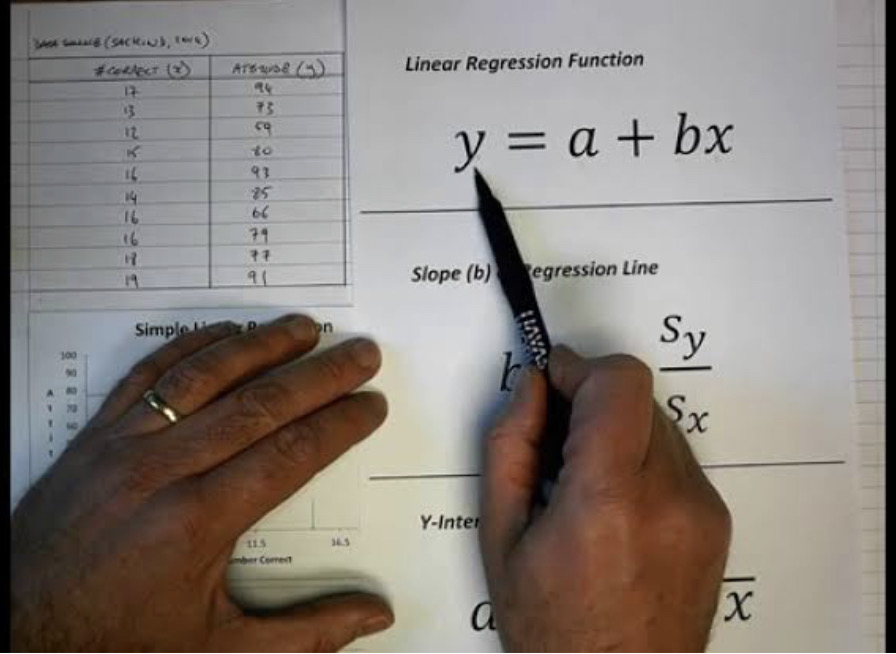
To perform a linear regression analysis, it is necessary to collect data on both the dependent and independent variables. Once the data has been collected, a statistical software program can be used to calculate the equation of the line that best fits the data. The equation of the line is typically represented in the form y = mx+ b or y=a +bx , where y is the dependent variable, x is the independent variable, m is the slope of the line, and b is the intercept.
The slope of the line represents the relationship between the independent and dependent variables. A positive slope indicates that there is a positive relationship between the variables, while a negative slope indicates that there is a negative relationship. The intercept represents the value of the dependent variable when the independent variable is equal to zero.
Regression analysis can be used for a variety of purposes. In finance, it can be used to predict stock prices based on economic indicators such as interest rates and inflation. In marketing, it can be used to predict sales based on advertising expenditures and other promotional activities. In social sciences, it can be used to predict the likelihood of certain behaviors based on demographic and psychographic factors.
There are several assumptions that must be met for linear regression to be valid. One assumption is that there is a linear relationship between the independent and dependent variables. If there is a nonlinear relationship, then linear regression may not be appropriate. Another assumption is that the errors in the prediction are normally distributed. If the errors are not normally distributed, then the accuracy of the predictions may be affected. Another important consideration when using regression analysis is the possibility of confounding variables. Confounding variables are variables that may be related to both the independent and dependent variables and may therefore affect the relationship between the two. It is important to control for confounding variables to obtain accurate predictions.
In conclusion, regression analysis is a powerful tool for predicting the value of a dependent variable based on one or more independent variables. Linear regression is the most common type of regression analysis, and it involves finding the equation of a straight line that best fits the data. Regression analysis can be used in a variety of fields and can be used for both prediction and explanation. However, it is important to ensure that the assumptions of linear regression are met, and to control for confounding variables, to obtain accurate predictions.
