
A probability distribution is a numerical measure of the likely hood that an event will occur.it is a branch of statistics that deals with the probability of various outcomes in each event
A probability distribution can be either discrete or continuous, depending on whether the set of possible outcomes is countable or uncountable.
In a discrete probability distribution, the possible outcomes are countable, and the probability of each outcome is assigned a specific value. For example, if we flip a coin twice, the possible outcomes are {HH, HT, TH, TT}, where H represents heads and T represents tails. The probability of each outcome can be calculated using the formula:
P(outcome) = (number of ways to get the outcome) / (total number of possible outcomes)
For example, the probability of getting two heads in a row (i.e., HH) would be:
P(HH) = 1 / 4
since there is only one way to get two heads (i.e., HH), and there are four possible outcomes.
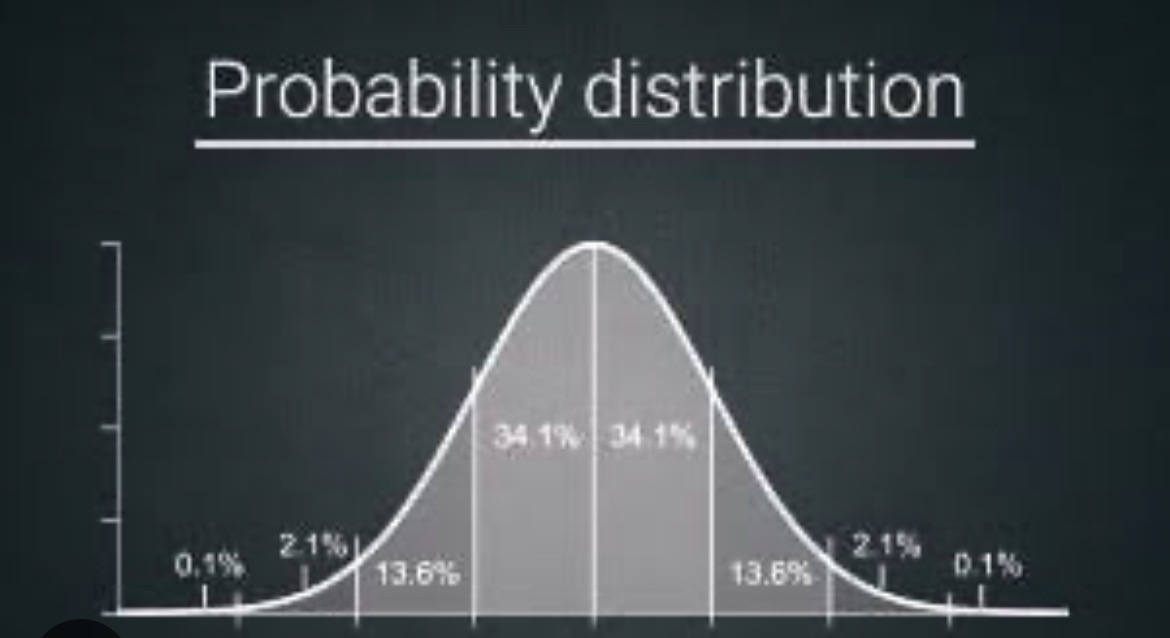
In a continuous probability distribution, the possible outcomes are uncountable, and the probability of each outcome is represented by a probability density function. For example, normal distribution is a continuous probability distribution that is often used to model random variables such as heights, weights, and test scores. The normal distribution has a bell-shaped curve and is characterized by its mean and standard deviation.
The mean of a probability distribution represents the average value of the outcomes, while the standard deviation represents the degree of variation in the outcomes. For example, if we flip a coin 10 times, the mean number of heads would be 5 (since the probability of getting heads is 0.5), and the standard deviation would be 1.58 (since the standard deviation of a binomial distribution with n trials and probability p of success is given by sqrt(np(1-p))).
Probability distributions can be used to make predictions and to calculate probabilities of certain events occurring. For example, in finance, probability distributions are used to model the returns of different investment portfolios and to calculate the risk associated with each portfolio. In engineering, probability distributions are used to model the failure rates of different components and to calculate the reliability of complex systems.
There are many types of probability distributions, each with its own characteristics and applications. Some of the most used probability distributions include:
- Binomial distribution: used to model the number of successes in a fixed number of trials.
- Poisson distribution: used to model the number of events occurring in a fixed interval of time or space.
- Exponential distribution: used to model the time between events in a Poisson process.
- Uniform distribution: used to model events that are equally likely to occur over a certain range.
In conclusion, probability distribution is a branch of statistics that deals with the probability of different outcomes in a random experiment. Probability distributions can be either discrete or continuous, and they can be used to make predictions and to calculate probabilities of certain events occurring. Probability distributions are used in many fields, including finance, engineering, and science, to model and analyze random variables and to make informed decisions based on the probabilities of different outcomes. Understanding probability distributions is essential for anyone who wants to use data to make informed decisions and predictions.

 Regression Analysis? Any need?