
Everywhere around the world, businesses are faced with new challenges everyday and managers must decide on which actions to take, and what risks are acceptable, one can agree that the process of making these decisions are quite painstaking and if not done strategically, can ruin a business. Today we will look at a mathematical strategy called linear programming and we will examine some of its uses in the modern day business world.
Linear programming is a mathematical optimization technique used to find the best solution for a given set of constraints and objectives. The technique is widely used in business to optimize resources, minimize costs, and maximize profits. In this blog post, we will explore the basics of linear programming and its application in business.
The basic concept of linear programming is to find the optimal values of decision variables that satisfy a set of constraints and maximize or minimize an objective function. The decision variables are the variables that can be controlled by the decision-maker, and the objective function represents the goal that needs to be achieved. As we are limited in this blog post, You can find more information on objective functions and decision variables HERE.
The constraints are the limitations on the decision variables. For example, in a manufacturing process, the constraint may be the availability of raw materials, the capacity of machines, or the maximum production capacity. The objective function is the measure of the success of the process, which can be expressed as a profit, cost, or revenue.
Linear programming is used in a wide range of applications in business. Some of the common applications are:
- Production planning and scheduling: Linear programming is used to determine the optimal production plan and schedule that maximizes the profit and meets the demand. The production plan considers the availability of resources, the capacity of machines, and the market demand.
- Inventory management: Linear programming is used to determine the optimal level of inventory that minimizes the cost of holding inventory and the cost of stockouts. The inventory level is determined based on the demand forecast, lead time, and ordering cost.
- Transportation and logistics: Linear programming is used to optimize the transportation and logistics network that minimizes the transportation cost and maximizes the efficiency of the network. The optimization considers the capacity of the transportation mode, the distance, and the demand.
- Financial planning: Linear programming is used to determine the optimal portfolio of investments that maximizes the return and minimizes the risk. The portfolio optimization considers the return, risk, and correlation of the assets.
- Marketing optimization: Linear programming is used to determine the optimal marketing mix that maximizes the revenue and minimizes the cost of production. The optimization considers the price, promotion, product, and place.
Linear programming has several advantages over traditional decision-making methods. The advantages are:
- Optimization: Linear programming provides an optimal solution that satisfies the constraints and maximizes or minimizes the objective function.
- Flexibility: Linear programming allows the decision-maker to change the constraints and the objective function to simulate different scenarios and find the best solution.
- Efficiency: Linear programming reduces the time and effort required to make a decision by automating the optimization process.
- Transparency: Linear programming provides a clear and objective basis for decision-making that can be easily communicated and understood.
From the above points, it is clear that linear programming is a powerful optimization technique. A technique that is widely used in business to optimize resources, minimize costs, and maximize profits. The technique is used in production planning, inventory management, transportation and logistics, financial planning, and marketing optimization. Businesses that use linear programming can make better decisions, increase efficiency, and achieve their goals more effectively while saving costs.
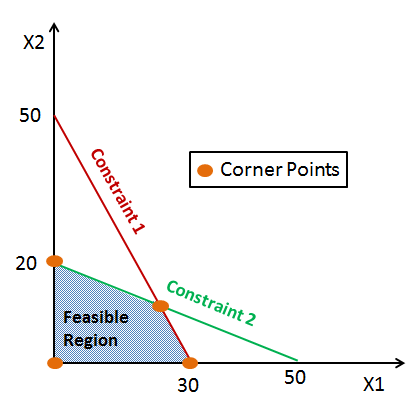
The Figure 1.0 below shows the correllation of constraints, shows their intersection and also shows the feasible region.
Fig 1.0

 CAPITAL RATIONING