
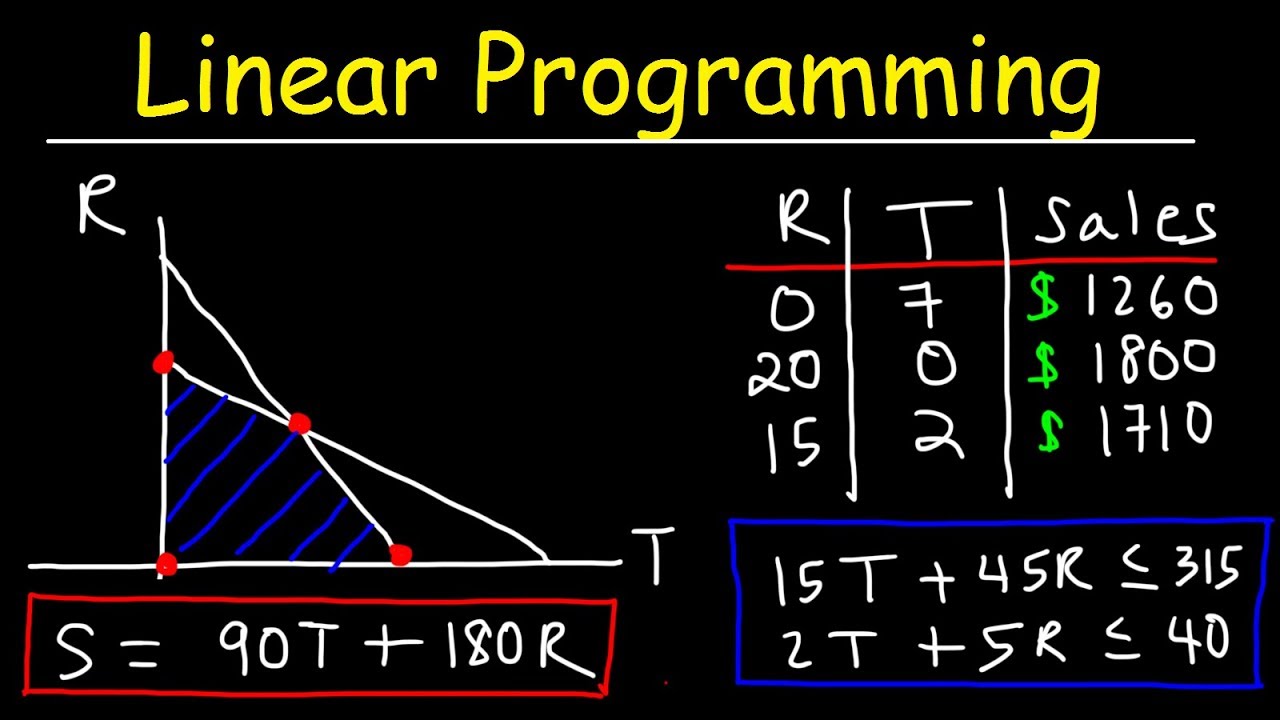
Linear programming is a mathematical modelling technique in which a linear function is maximised or minimised when subjected to various constraints. It can also be described as the optimisation technique used to find the optimal solution to a problem that involves linear constraints and a linear objective function. Linear programming is widely used in various industries, including finance, manufacturing, transportation, and agriculture. In this post, we will discuss the basics of linear programming, it’s applications, and how it works.
Basics of Linear Programming
Linear programming involves maximising or minimising an objective function subject to a set of constraints. The objective function is a linear equation that represents the quantity to be maximised or minimised, such as profit or cost. The constraints are linear equations or inequalities that represent the limitations of the problem, such as resource constraints or production capacity.
Linear programming problems can be solved using graphical methods or algebraic methods. Graphical methods involve plotting the constraints and objective function on a graph and finding the optimal solution by analysing the intersection points. Algebraic methods involve using matrix operations and linear algebra to find the optimal solution.
Applications of Linear Programming
Linear programming has many applications in various industries. Here are a few examples:
1. Finance: Linear programming is used in portfolio optimisation, which involves finding the optimal mix of assets to maximise returns while minimising risk.
2. Manufacturing: Linear programming is used in production planning, which involves finding the optimal production schedule to minimise costs and maximise profits.
3. Transportation: Linear programming is used in logistics planning, which involves finding the optimal routes and schedules to minimise transportation costs and maximize efficiency.
4. Agriculture: Linear programming is used in crop planning, which involves finding the optimal mix of crops to maximize yield while minimising costs.
How Linear Programming Works
Linear programming works by finding the optimal solution to a problem by maximising or minimising the objective function subject to the constraints. The optimal solution is found by using an algorithm that involves iteratively refining the solution until the optimal solution is found.
Sometimes, we use the geometrical method to solve linear programming problems, but the geometrical approach will not work for problems that have more than two variables. In real life situations, linear programming problems consist of literally thousands of variables and are solved by computers. We can solve these problems algebraically, but that will not be very efficient.
We therefore need a method that has a systematic algorithm and can be programmed for a computer. The method has to be efficient enough so we wouldn’t have to evaluate the objective function at each corner point. This method is called the simplex method.
The simplex method involves starting with an initial feasible solution and then iteratively improving the solution until the optimal solution is found. The simplex method works by identifying a variable to enter the solution and a variable to leave the solution. The algorithm then updates the solution by increasing the entering variable and decreasing the leaving variable until the optimal solution is found.
This method uses an approach that is very efficient. It does not compute the value of the objective function at every point; instead, it begins with a corner point of the feasibility region where all the main variables are zero and then systematically moves from corner point to corner point, while improving the value of the objective function at each stage. The process continues until the optimal solution is found. #EMBA28

 AUDITOR CHARACTERISTICS AND LIKELIHOOD OF FINANCIAL DISTRESS: EMPRICAL EVIDENCE FROM NIGERIA AND SOUTH AFRICAN FMCG SECTOR