
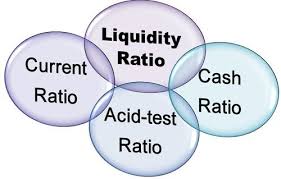
In this series we would focus on the Liquidity ratios which helps us understand the working capital position of a company. Working capital can be explained in financial terms as what a company needs to meet its short-term needs. The ratio under this category are the current ratio, quick ratio, and cash ratio.
The current ratio is calculated as the total current assets divided by its total current liabilities. It is usually expressed in ratio terms but can also be expressed in percentage terms. The current ratio is an indication or measure of a company’s liquidity regarding its short-term obligations, usually within the next 12 months. Some industries like FMCG and Hospitality industries explain a 2:1 ratio as a standard acceptable measure while the exploration industry sees a 1.5:1 ratio as a standard. This is due to the huge capital requirements of the latter and the cash base that is associated with the former.
The quick ratio, which is also referred to as the acid test ratio, is used to check the ability of a company to use its very liquid assets to cover its short-term obligations. It is calculated as the total current assets less its inventory divided by its total current liabilities. A 1:1 ratio is generally regarded as the standard although this may differ amongst industries.
The cash ratio is a liquidity measure that shows a company’s ability to cover its short-term obligations using only cash and cash equivalents. The cash ratio is calculated by adding a company’s total reserves of cash and near-cash securities and dividing that sum by its total current liabilities. The cash ratio is more conservative than other liquidity ratios because it only considers a company’s most liquid resources. A calculation greater than 1 means a company has more cash on hand than current debts, while a calculation less than 1 means a company has more short-term debt than cash. Lenders, creditors, and investors use the cash ratio to evaluate the short-term risk of a company.
When reviewing a company’s liquidity performance, the cash conversion cycle is also a very important metric to review. It is calculated by adding the inventory turnover period to the receivables collection period and the creditors payable period is deducted. This shows the average length of time between paying production costs and receiving cash returns from the inventory. The cash conversion cycle over several years can reveal an improving or worsening value when tracked over time. Cash conversion cycles depend on industry type, management, and many other factors. However, the fewer days it takes to convert resources to cash, the better it is for the business.
On its own, cash conversion cycle might not mean much. Instead, it should be used to see if a company is improving over time and to compare it to its competitors. During an analysis, the cash conversion cycle should be combined with other metrics, such as return on equity and return on assets, and can be useful when comparing competitors. The company with the lowest cash conversion cycle is often, but not always using its resources more efficiently.
References;
- Investopedia. (2022). Cash Ratio: Definition, Formula, and Example. [Online]. Investopedia. Available at: https://www.investopedia.com/terms/c/cash-ratio.asp#:~:text=The%20cash%20ratio%20is%20a%20liquidity% [Accessed 8 April 2023].
- Kaplan. (2021). Strategic Business Reporting (SBR-INT/UK). Unit 2 The Business Centre Molly Millar’s Lane Wokingham Berkshire RG41 2QZ: Kaplan Publishing UK. pp.558-595.

 Analysis of the BCPC Internet Strategy team