
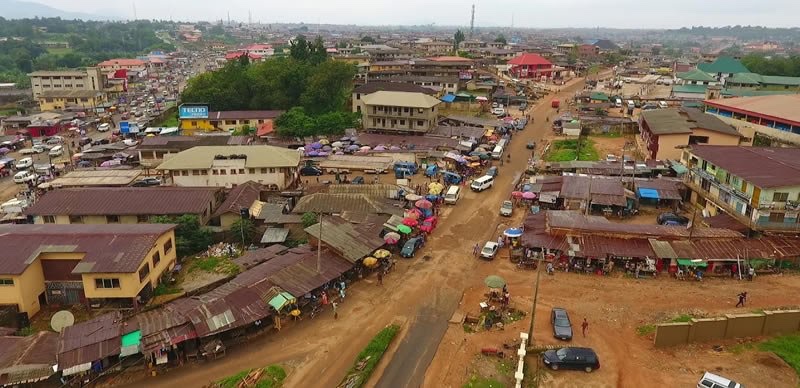
Story Of The Ife and Modakeke war of 1835–2000, which according to history was one of the longest intra-ethnic wars in Yorubaland. According to legend, Ifes and Modakekes are the sons and daughters of the same parents. Their ancestors can be traced back to Oduduwa, the Yoruba race’s progenitor. The collapse of the Old Oyo Empire in the 19th century resulted in a flow of refugees down south, prompting one of the exiled Oyo groups to settle in what is now known as Modakeke. Modakeke has been a town for almost two hundred and fifty years (250 years). It has its own traditional system, which includes a traditional monarch and a chieftaincy hierarchy. It is proud of its demographic, economic, and cultural progress, as well as its contributions to national development in all areas.
History of Modakeke: The name Modakeke was derived from an Ako (Stork) bird that was commonly seen in the new community. The Ifes discovered the stork chirping a rhyme they called mo-da-ke-ke-ke-ke-ke-ke-ke-ke-ke-ke-ke-ke-ke-ke-ke-ke-ke-ke-ke-ke-ke-ke-.As a result, the residents of Ife chose the name “Ife” for this new settlement, “Modakeke.” Following the Fulani conquest of the Oyo Empire, the entire Oyo population was plunged into disarray. The Oyo Empire, which was then one of the most powerful and well-fortified empires, crumbled and never recovered from its former greatness. However, in search of a better life, the people of Ibadan swiftly dispersed across Yoruba territory. Therefore, in 1834, some of them moved to Ile-Ife to start a new life.
The inhabitants of Ife welcomed them warmly, and they coexisted peacefully with the rest of the town. They were quite hardworking, and they began cultivating the area to raise a variety of crops. Oba Akinmoyero, the ruling Ooni of Ife at the time, was exceedingly delighted with them and even took some of their warriors into his army. Ife was able to extend her boundaries to Alakowe, the current border between Ife and Ilesa, thanks to the valour of the Ibadan troops. Prior to the coming of the Ibadan people, the Ijesas had their domain stretched to the current location of the Ooni of Ife’s Palace, which is still known as Enuwa (Enu Owa). The Ibadan people would later provide the Oba Akinmoyero with a plot of land outside the city walls of Ife as a token of their gratitude for their valour.
History of Ile-Ife: Ife (Ile-Ife) is a Yoruba city in the southwestern part of Nigeria. The city is now located in the state of Osun. Ile-Ife was discovered by Oduduwa, Obatala’s younger brother, whom the supreme God Olodumare sent to build the earth, according to Yoruba mythology. According to legend, Obatala drank palm wine on his trip to create the earth and became so inebriated that Oduduwa had to take up his task. Oduduwa took Obatala’s three objects of creation, climbed down from the heavens on a chain, threw a handful of soil on the primordial ocean, and then put a cockerel on it to distribute the earth, thereby creating the land on which Ile-Ife would be built. Thus, glass beads made by ancient Ife have been discovered as far as Mali, Mauritania, and Ghana.
To be continued next week, stay tuned. Thanks

 Why I am doing an MBA in Lagos Business School.