
#MMBA 4
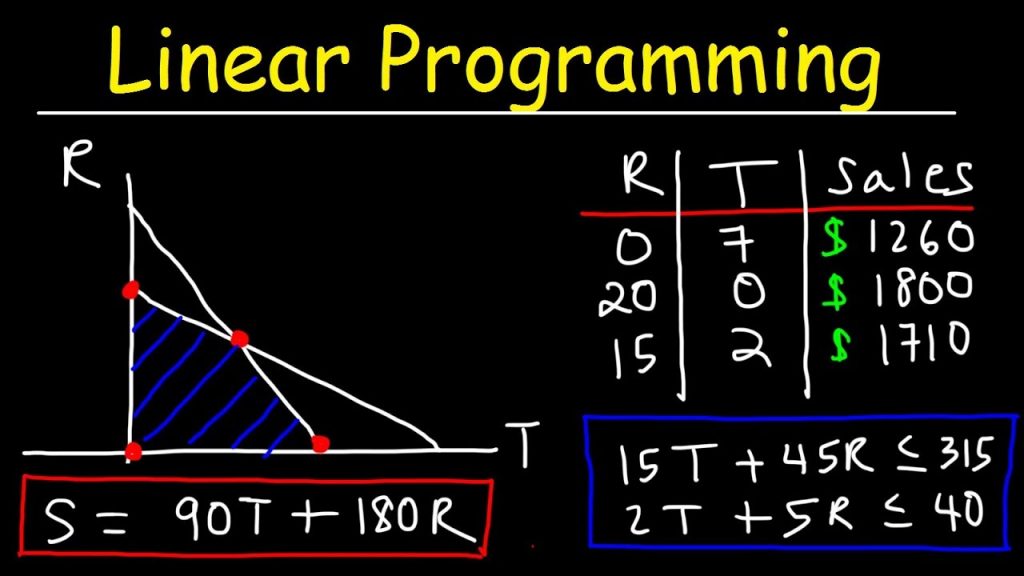
I already told you I signed up for a time demanding course right, I am currently doing my MBS at the prestigious Lagos business school, part of the module I am currently doing is data analytics and today we treated a new topic called linear programming.
Linear programming is a mathematical optimization technique that permits us to determine the optimal solution to a problem with linear constraints. Several sectors, including as economics, engineering, and finance, can benefit from its use. In this article, we will cover the fundamentals of linear programming and its operation. It is a way to find the best solution for an objective function that is linear and has constraints that are linear and either different or the same. In other words, it is a mathematical method used to find the best solution given a set of rules, or constraints. Linear programming is used to solve problems that involve maximizing or minimizing a linear objective function while meeting constraints that are linear equations or inequalities. The objective function is a mathematical expression that describes what is being optimized in the problem. On the other hand, the constraints are mathematical expressions that limit the possible values for the variables. The best answer to a linear programming problem is either the maximum or the minimum value of the objective function.
In linear programming, a mathematical model consisting of an objective function and a set of constraints is used. The objective function is the expression we wish to optimize, whereas the constraints are the limitations within which we must operate. Determining the objective function and constraints is the first step in solving a linear programming problem. After defining them, we can apply mathematical methods to determine the ideal solution. In linear programming, the two primary approaches that are utilized are known as the graphical method and the simplex method. The restrictions are placed on a graph using the graphical method, and then the feasible region is located using that graph. The feasible region is the collection of all possible solutions that can fulfil the requirements of the problem. The next step in finding the best solution is locating the point inside the feasible region that either maximize or minimize the value of the objective function.
The simplex method, on the other hand, is a method that entails transforming the linear programming problem into a standard form. This leads to a greater level of efficiency. To use this approach, you must first describe the constraints as equality, and then add slack variables to the objective function. The slack variables stand for the amount that the constraints can be loosened up to without the solution to the original problem being compromised.
The simplex approach can be utilized to locate the best solution to the linear programming problem once it has been transformed into standard form. A basic feasible solution is the beginning point for the approach. This is a solution that meets the requirements with equality. After that, the solution will go through a series of iterative improvements until the best possible answer is determined. In a wide variety of contexts, linear programming can be applied in a variety of ways. The following are examples of some of the most common applications, supply chain management, resource allocation , financial planning etc.

 Important Lessons from an Air Traveller