
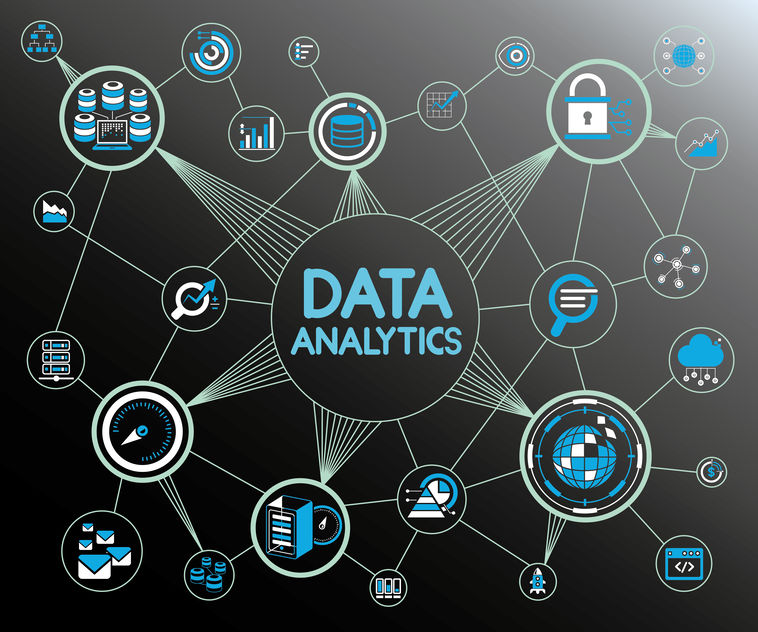
Data analytics is about finding hidden trends, correlations, and other insights that can guide business choices. It includes analyzing and interpreting data using a range of statistical and computational methods, frequently with the aid of specialist software tools such as Tableau, Excel. Data analytics is essentially the process of taking large and complex data sets and turning them into concrete thoughts that can inform decision-making. It typically involves several key steps, such as:
- Data collection which is the gathering and storing of data from a variety of sources.
- Data preparation which is the removal of errors, inconsistencies, or missing values, as well as transforming the data into a format that is suitable for analysis.
- Data analysis where various statistical techniques are used to uncover said patterns, correlations, and other insights in the data.
- Data visualization to present the analysis in a way that is easily understandable and visually appealing. Such as charts, graphs, and other visualizations that help communicate the insights.
There are many different techniques and tools that can be used to analyze data, depending on the type of data being analyzed and the specific insights that are being sought. These include descriptive analytics, predictive analytics, and prescriptive analytics.
- Descriptive analytics is used to find patterns and trends in past data These metrics are frequently used to learn more about consumer behavior, market patterns, or website traffic. Data visualization, pattern analysis, and grouping are a few descriptive analytics methods.
- Predictive analytics uses statistical models to forecast future outcomes based on past data. It involves the use of statistical models to forecast future outcomes such as the forecasting of sales revenue. Examples of predictive analytics techniques include regression analysis and time-series forecasting.
- Prescriptive analytics uses sophisticated algorithms and optimization methods to suggest the best course of action in light of the data analyzed. It is used in applications such as supply chain optimization, financial portfolio management, and healthcare treatment planning. Examples of prescriptive analytics techniques include linear programming, simulation modeling, and optimization algorithms.
In summary, the field of data analytics encompasses a wide range of techniques and approaches, each with its own strengths and applications. Descriptive analytics provides insights into past trends and patterns, while predictive analytics helps forecast future outcomes. Prescriptive analytics goes beyond prediction and provides actionable recommendations to drive better decision-making.
Data analytics is used in a wide range of industries, including finance, healthcare, marketing, and e-commerce. It can help organizations make more informed decisions, improve business processes, and identify opportunities for growth and innovation.
- In finance, data analytics is used to analyze financial data and identify patterns and trends that can inform investment decisions, manage risk, detect fraud, and optimize portfolio performance.
- Data analytics in healthcare is used to improve patient outcomes, reduce costs, and optimize operations. It is used to analyze patient data to identify trends and patterns, improve clinical decision-making, and develop personalized treatment plans.
- In marketing, data analytics is used to analyze customer data to understand customer behavior, preferences, and buying habits. It has been used to optimize marketing campaigns, and target specific customer segments.
- In e-commerce, data analytics is used to optimize the customer experience, and increase revenue. It is used to understand customer behavior, identify opportunities for upselling or cross-selling, and optimize pricing strategies.
In conclusion, data analytics is used in a variety of sectors to enhance company operations, find growth and creative possibilities, and guide decision-making. Organizations are able to better understand consumer behavior, streamline processes, and produce better results by studying large and complicated data sets.
