

My discussion continues on Gravity Payments and the 2015 controversial decision made by Dan Price to raise the minimum wage for all employees to $70,000 per year, regardless of their job title or position within the company.
I raised questions around the happenings at Gravity bordering on its business sustainability, code of business conduct & corporate governance, lawsuit, media, employees and the company’s customers.
To answer these questions, context need to be set on Dan and his vision for the company and its future.
Who is Dan? What motivated him to start Gravity? What had Gravity done prior to the employee decision in 2015?
- He started Gravity in 2004 at age 19, after finding that small business owners were being overcharged by credit card companies and paying as much as 5% to process their payments.
- Gravity charged less than half of the industry-average processing rate.
- Gravity Payments had had a philanthropic mandate since inception in 2004.
- Gravity in 2008 launched the “Gravity Gives” program and gave away 2% of the company’s revenue to charity.
What kind of business does Gravity run and how does it manage to stay profitable?
- Type of business: private credit card processing and financial services company servicing mostly small and medium-sized businesses.
- By 2008 (4 years after it started business) the company became the largest credit card processor in the state of Washington, serving more than 15% of small businesses in the Seattle area.
- Profit Margins for Gravity’s business is thin, hence ensuring high revenues will support the overall profitability of the company.
- The company’s three success factors were: (a) its low-cost strategy (b) word of mouth publicity, i.e. satisfied customers referrals (c) low interest rates to drive revenue.
Armed with the above context, here are my views and recommendations.
Going Concern and where employees fit in
Short and medium-term sustainability of the business will not be an issue for Gravity. Why? Given the nature of its business, it requires a high turnover to stay afloat in a business with very thin net profit margins. Given that revenue is driven by price and volumes, Gravity had promised its customers that they would not increase prices so the focus will be on increasing volumes. Driving volumes of transactions would need highly motivated staff to put in their best efforts to recruit new clients.
Employees who choose to remain with Gravity over the three-year period would want to help the person and business that improved their lives to stay afloat which is achievable. A high-level conservative summary on how the business results of the company could look like over the next few years show that the company would most likely remain a going concern.
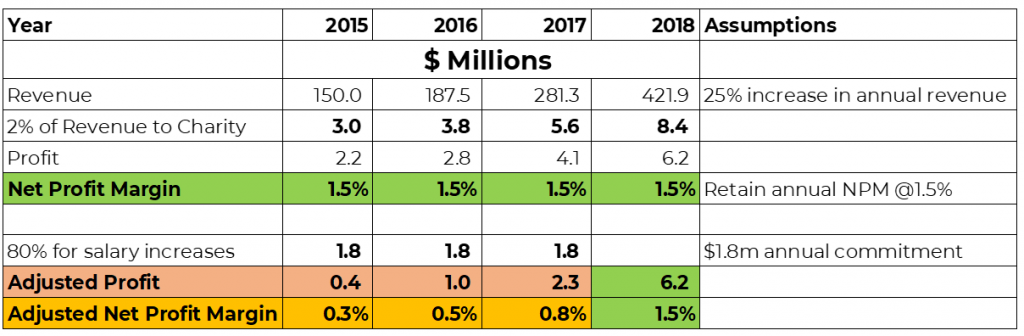
My recommendation to ensure that business still thrives is to lock in the loyalty of all employees by linking their increased annual wages to performance where each employee is given stretch targets to put in their best.
Customers of Gravity were already growing due to the positive media from its CEO’s announcement. Gravity should latch on the ‘free media attention’ to drive sales in addition to the company’s customary word of mouth publicity. The media attention could have them growing their business to cover small and medium businesses outside of Seattle. Experienced talents and new staff should be recruited to cover this new business opportunity. Good hands would be very happy to work for a company like Gravity to grow its revenue and profits.
Employees – Equality versus Equity
A salary differentiation surely ought to be put in place for Senior and Management staff who already put in their best efforts through their experience, years of service, quality of work and supervision which ought to be recognised and compensated. Gravity would loose experienced hands and may not find people internally who would aspire to fill senior roles as compensation. The risk still remains that hiring new experienced persons would require a learning curve which in the short term may not be very strategic and loose out on the low hanging fruits from the media spin in their favour and the sharp rise in their client base . Dan should consider adjusting the pay to also motive the senior employees while seeking out new talents close these gaps.
I still have a few notes to share on Gravity’s Code of Business Conduct, Corporate Governance, the Lawsuit and if this feat can be replicated by other businesses. I’ll share those in my last episode on this case.
htuR #EMBA 28

 Decision-making and Impact of Consultation