
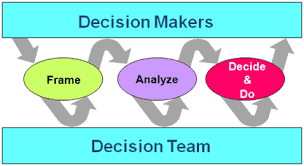
How do we analyze decisions? Decision analysis can be used to develop an optimal strategy by a decision maker, by optimal strategy I mean the best strategy for the decision analysis. For instance, if you are a manager in an organization your goal should be to maximize profit for the organization equally in our personal lives our goal is to make the best decision always. Most times, a decision maker is faced with several decision alternatives, uncertainties, and risks. Uncertainty means you are not sure of the decision options and risk means you are not sure of the risk that will crystalize in each likely event. Every likely event would have a risk profile and the only way is to know what strategy is best in making a decision alternative.
When a careful decision analysis has been conducted the uncertain future events make the final consequences uncertain. The risk associated with any decision alternative is a direct result of the uncertainty associated with the final consequence. Good decision analysis includes risk analysis, this risk analysis provides probability information about the favorable consequence that may occur. Good decision analysis includes risk analysis which would give you information on the probability of favorable and unfavorable outcomes.
The next question is What is the probability of favorable outcomes? And What is the probability of unfavorable outcomes? Once you can answer this question, you will have it clear and then you will decide whether you want to go with the outcome or not.
Step 1: Formulate the problem
A decision problem is characterized by decision alternatives, the state of nature, and resulting payoffs. The decision alternatives are different possible strategies the decision maker can use. The state of nature refers to future events, not under the control of the decision-maker which may occur. State of nature should be defined so that they are mutually exclusive and collectively exhaustive. For instance, there are plenty of options you need to decide from which am I going with option A or option B or option C and not overlapping alternatives, if you take option A it means you would not take option B, each alternative is on their own that is why they are called decision alternatives and are they are mutually exclusive.
State of Nature: Although the decision maker can decide to do either option A or option B but remember nobody controls nature, for instance, you set up a factory that produces these water bottles and you plan to make as much profit as possible, what will determine your profit is your sales? What determines sales? It is not the decision maker that determines sales, you have produced the water bottles but the demand is now low, and the demand is not within your control, that is the state of nature that is the risk. Remember, it cost you money to produce the water bottles and now demand is low which is the actual risk.
In the example given above, so you can have demand low, demand medium, and demand high. All these are called States of Nature because they are not within your control and that is where the risk is. How do you now quantify the risk of this? You now have to factor this state of nature into your decision-making. Now you have to decide the state of nature and ensure that they are mutually exclusive and collectively exhaustive. Hence, we would assign a probability such that the probability of high, low, and medium will sum up to 1.
Influence Diagram: This is a graphical device showing the relationships among the decisions, the chance events, and the consequences.
Squares or rectangles: depict decision nodes or decision alternatives.
Circles or ovals: depicts chance nodes.
Diamonds: depicts consequences nodes lines or arcs connecting the nodes show the direction of influence.
Payoff table: The consequences resulting from a specific combination of a decision alternative and a state of nature is called payoff. A table showing payoffs for all combinations of decision alternatives and state of nature is a payoff table.
#MBA 21

 INSIDER TRADING – AN ANALYSIS OF THE MARTHA STEWART’S (ImClone) CASE