
Professor Bongo since his initial session, has consistently demonstrated a commitment to imparting contemporary industry data analytics skills to us. He has progressively familiarized us with the practical realm of data analysis, utilizing software tools like Python, Microsoft Excel, Power BI, and Postgres SQL. In tandem, he has fueled our enthusiasm to explore additional intriguing data analytic software, including R-Studio. The seventh session, Professor Bongo’s inaugural theoretical discussion on probability, was enlightening and enjoyable. It was marked by his humorous interactions with students, detailed and practical explanations, and the inclusion of learning about broader aspects of life.
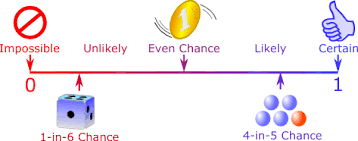
Probability measures the likelihood of an event occurring, represented by a number between 0 and 1. It stands in contrast to uncertainty, which involves not knowing or having information about the potential outcomes of an event, often due to unpredictability or lack of information. Uncertainty commonly arises in situations with multiple potential outcomes, and insufficient information to determine which specific outcome among the possibilities will occur. For example, an event planner preparing for an outdoor event later in the evening may be uncertain about the weather conditions—whether it will rain or be sunny. In essence, probability is associated with the concept of likelihood, indicating the chance of an event happening, while uncertainty pertains to a state of unawareness or lack of knowledge about the outcome. The connection between the two lies in that uncertainty can influence how we assess or estimate probabilities.
Uncertainty exists in three forms: aleatoric (probabilistic), epistemic, and Knightian. Aleatoric uncertainty arises from hidden or unknown factors affecting a situation or outcome. These factors may be challenging to measure accurately, making precise predictions difficult. Aleatoric uncertainty is associated with randomness, where the probability distributions are known, but specific outcomes are unknown. It involves having a general estimate of likely occurrences without the ability to predict the exact outcome. For instance, consider planning an outdoor event with a weather forecast indicating a 60% chance of rain. While the likelihood of rain is known (60% probability), specific details such as when or how it will rain remain uncertain.
Similarly, regarding the economic context of Nigeria, we may know the three possible outcomes for the country’s economy in 10 years (better, unchanged, or worse), and we can use economic and probabilistic concepts to predict the outcome while specific or precise result remains uncertain.
Epistemic uncertainty arises from a lack of knowledge or information. Unlike aleatory uncertainty, where probability distributions are known, there is insufficient data or expertise to accurately predict an outcome in epistemic uncertainty. This uncertainty can be mitigated to some extent by continuous efforts to gather information through research or expertise in relevant fields. For instance, scientists searching for a cure for certain types of cancer face epistemic uncertainty because there is still little information regarding the biological patterns of these cancer cells and potential treatments. As more research is conducted and knowledge is acquired, epistemic uncertainty can be reduced.
Knightian uncertainty, as postulated by economist Frank Knight, represents the extreme form of uncertainty. In this type of uncertainty, there is complete blindness to the probabilities of different outcomes. Unlike aleatoric uncertainty, where probabilities are known to predict an occurrence, or epistemic uncertainty, where information is generated through continuous research and exploration, Knightian uncertainty is characterized by a lack of information in estimating the likelihood of an event occurring. An example of Knightian uncertainty is a situation where a decision needs to be made regarding an investment in a start-up. Since it is a start-up, there is not enough information to make estimates of its likelihood of success or failure, thereby creating Knightian uncertainty.
The study of probability is crucial for understanding and drawing conclusions about uncertainties based on the probabilities of occurrence. It provides us with the tools to analyze the likelihood of various outcomes of events and their associated risks, enabling us to make informed decisions based on these predictions.



