
In the world of finance, accuracy and detail are paramount. The double-entry system of accounting, a method pioneered by Luca Pacioli in the 15th century, stands as the bedrock of financial accuracy. This system ensures that every financial transaction affects at least two accounts in contrasting ways – through a debit in one and a credit in another. You give up one thing to receive another. This fundamental approach underpins the reliability and comprehensiveness of financial reporting, making it an indispensable tool in modern accounting.
At the heart of the double-entry system are the concepts of debits and credits. These are not just mere entries but are the yin and yang that keep the accounting world in balance. The system revolves around five core account types: assets, liabilities, equity, revenues, and expenses. The golden rule? For every transaction, the total debits must equal the total credits, maintaining the foundational accounting equation: Assets = Liabilities + Equity.
Dispelling Confusion: Accounting is Not Banking
A common area of confusion lies in differentiating accounting practices from banking transactions. While banks use a similar language of debits and credits, their application differs significantly. For instance, a bank’s loan to a business (for example, Tao’s Cafe) appears as an asset in the bank’s books but as a liability in Tao’s Cafe’s ledger. Furthermore, banking regulations and accounting standards operate on different planes, each with its distinct compliance requirements.
Shortcuts and Acronyms: The Accountant’s Toolkit
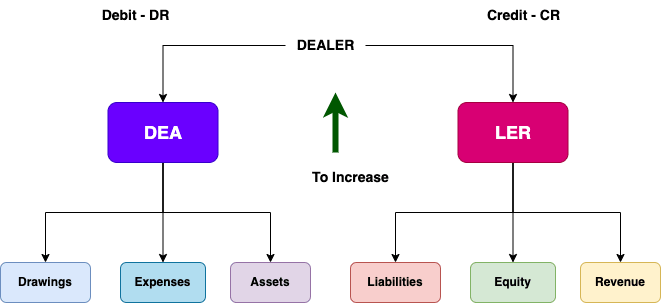
Accounting, like any specialized field, has its jargon and shortcuts. Acronyms like ALOE (Assets, Liabilities, Owner’s Equity) and DEAD (Debits, Expenses, Assets, Dividends) help professionals recall fundamental principles swiftly. Mnemonic devices, such as “DEALER” (Debits: Dividends, Expenses, Assets; Credits: Liabilities, Equity, Revenue), serve as quick reference guides in the maze of financial transactions.
Bringing Theory to Life: Tao’s Cafe
Let’s take a practical example to illustrate these concepts. Imagine Tao owns a cozy café called Tao’s Cafe, and he purchased coffee beans worth $1,000 on account. In his ledger, this transaction would be recorded as a debit of $1,000 to the inventory (an asset account) and a credit of $1,000 to Accounts Payable (a liability account). This entry simultaneously reflects the increase in his café’s inventory (asset) and the obligation to pay the supplier (liability).
Journal and Ledger Entries for Tao’s Café Purchase
Journal Entry:
The journal is where all transactions are initially recorded. This entry would look something like this:
| Date | Account | Debit ($) | Credit ($) |
| 2023-12-06 | Inventory (Asset) | 1,000 | |
| 2023-12-06 | Accounts Payable | 1,000 |
Explanation:
Inventory (Asset): This account is debited because the purchase increases Tao’s café’s inventory, an asset.
Accounts Payable: This account is credited to record the obligation to pay the supplier, increasing your liabilities.
Ledger Entries:
After recording in the journal, these transactions are then posted to the respective ledgers (books of account) for each account.
Inventory (Asset) Ledger:
| Date | Description | Debit ($) | Credit ($) | Balance ($) |
| 2023-12-06 | Purchase of coffee beans on account | 1,000 | 1,000 |
Accounts Payable Ledger:
| Date | Description | Debit ($) | Credit ($) | Balance ($) |
| 2023-12-06 | Purchase of coffee beans on account | 1,000 | 1,000 |
Summary:
In the inventory ledger, the balance increases by $1,000, reflecting the addition of coffee beans to your inventory.
In the Accounts Payable ledger, the balance also increases by $1,000, representing the amount owed to the supplier.
This example demonstrates how a single transaction impacts two different accounts in the double-entry system, ensuring that the accounting equation remains balanced. The journal entry is the initial record, while the ledger entries provide an account-specific view of the transaction’s impact.




 Stress and coping Strategies