
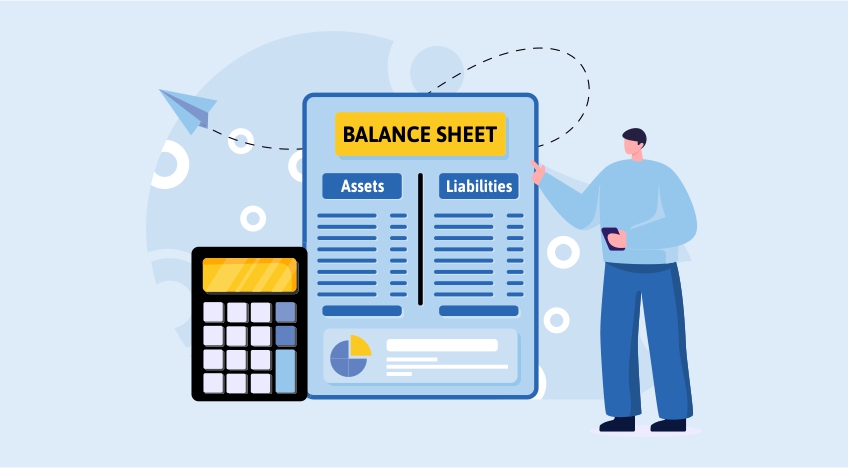
The Balance Sheet a.k.a. The Statement of Financial Position shows a company’s financial worth at a glance at a particular date. In other words, it shows as of a particular point in time, the kinds of resources available for use by the company and the sources of the resources. This statement consists of 3 core elements: Assets, Equity, and Liability. Resources = Assets. Sources = Equity and liabilities. As a cardinal rule of the balance sheet, Assets = Equity + Liabilities. Assets and Liabilities are either current or non-current. Assets could also be tangible (physical assets that have finite monetary value and be touched or physically measured: land, building, machinery) or intangible (Non-physical assets without a physical substance that provides a future economic benefit to its owner. These assets lack a physical presence but hold significant value for a company: intellectual property, goodwill, software and licenses, and brand recognition).
Assets
Assets are the resources owned by the company that have economic value and are expected to provide future benefits.
Current assets: assets that are expected to be converted into cash or used up within a year. They are crucial for a company’s day-to-day operations. Examples of current assets are cash and cash equivalents, account receivables (money owed by customers), inventory (goods for sale), prepaid expenses (expenses paid in advance), and short-term investments.
Non-Current assets: assets held for more than one year and not expected to be converted into cash quickly. They provide benefits over a longer time. Examples: Property, Plant and Equipment, intangible assets, and long-term investments.
Liabilities
Liabilities represent a company’s obligations or debts that it owes to external parties.
Current liabilities: obligations/debts that are expected to be settled within one year or the company’s normal operating cycle, whichever is longer. They are typically associated with day-to-day operational expenses. Examples: Accounts payable (money owed to vendors), accrued liabilities (unpaid expenses like wages, utilities), taxes payable, short-term debt, and deferred revenue(payment received for goods not yet provided/delivered).
Non-current liabilities: obligations that are not expected to be settled within one year. They represent longer-term financial commitments. Examples: deferred tax liabilities (taxes payable in the future), pension obligations (promised benefits to retired employees), lease liabilities (long-term lease agreement), and long-term debt.
Equity
Also known as shareholder’s equity represents the residual interest in the assets of a business after deducting its liabilities. It is what is left for the owners if all the company’s debts are paid off. Equity = Assets – Liabilities. Equity consists of 2 main components: contributed capital and retained earnings. Contributed capital also known as paid-in capital is the amount of capital contributed by the shareholders to operate the business. It also includes investments made by the owners/shareholders through the purchase of shares. Retained earnings are the accumulated profits or losses of the business since its inception. It includes net income (or loss) generated by the company over time, less any dividend paid out to shareholders.
Practical example:
Company: XYZ Services
Financial Figures for XYZ Services:
Cash: $50,000
Accounts Receivable: $30,000
Inventory: $20,000
Property, Plant, and Equipment (PPE): $100,000
Accounts Payable: $15,000
Short-term Debt: $10,000
Long-term Debt: $40,000
Shareholders’ Equity: $135,000
Question:
Based on the provided financial figures for XYZ Services, prepare a balance sheet for the company.
Balance Sheet of XYZ Services
As of 31st, December, 2022
Assets Amount (USD) Liabilities and Shareholders’ Equity Amount (USD)
Assets: Liabilities:
Cash $50,000 Accounts Payable $15,000
Accounts Receivable $30,000 Short-term Debt $10,000
Inventory $20,000 Long-term Debt $40,000
PPE $100,000 Total Liabilities $65,000
Total Assets $200,000
Shareholders’ Equity:
Shareholders’ Equity $135,000
Total Liabilities and Equity $200,000
Notes:
Current Assets
Cash: $50,000
Accounts Receivable: $30,000
Inventory: $20,000
Non-current Assets
Property, Plant, and Equipment (PPE): $100,000
Current Liabilities
Accounts Payable: $15,000
Short-term Debt: $10,000
Long-term Liabilities
Long-term Debt: $40,000
Shareholders’ Equity:
Shareholders’ Equity: $135,000
This balance sheet presents the financial position of XYZ Services as of 31st December, 2022, detailing its assets, liabilities, and shareholders’ equity.




 The Paradox of Auditing: Unraveling the Myth of a “Correct” Audit