
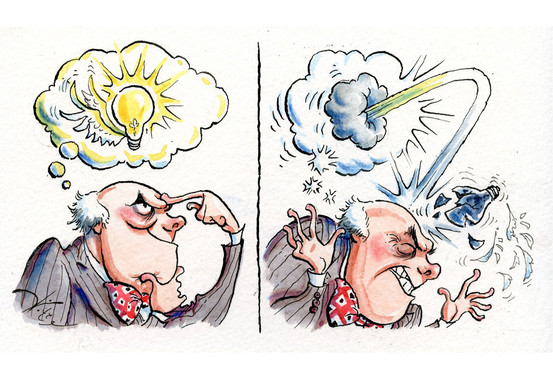
Did you know that every human brain has a dual system of thinking? According to Israeli-American psychologist and Nobel Laureate, Daniel Kahneman, the human mind is made up of two systems. They are called the two systems of thinking and are identified as System 1 and System 2 which respectively produce fast and slow thinking. I call them the odd couple of cognition.
System 1 which I would like to refer to as Professor Autopilot, is responsible for fast thinking characterized by unconscious, emotional, intuitive, impulsive, automatic, and effortless thinking without self-control or awareness. Professor Autopilot’s major role is to assess the situation and deliver updates to you as fast as possible. It is responsible for 98% of your thinking.
Have you ever had a moment where you said something without thinking, and then immediately regretted it? Or maybe you’ve made a decision that seemed like a good idea at the time, but turned out to be a mistake? Well, that’s Professor Autopilot at work. System 1 isn’t perfect and can lead to snap judgments, biases, and errors. For example, it can cause you to make impulsive decisions, like making that impulse purchase you didn’t need or jumping to conclusions without all the facts.
System 2 on the other hand is deliberate and an analytical thinker. I would refer to System 2 as Professor Slow Motion. It is effortful, controlled, self-aware, logical, and skeptical. It is responsible for rational thinking and controlled mental processes. It’s also the part of our brain that we use when we need to solve a complex problem, or when we need to make a decision that has important consequences. It is all about careful consideration and reasoning. However, Professor Slow Motion does just 2% of our thinking and is the direct opposite of Professor Autopilot. For instance, it took me 2 days to write this blog post because I had to wait for my system 2 to kick in. While System 2 is excellent for solving complex problems, it can also be a tad bit slow. This mode of thinking demands your full attention and can be mentally draining. That’s why you might feel exhausted after a long day at work.
These two naughty professors work together behind the scenes, often without our conscious awareness. Some relatable examples to understand how they work are listed below:
- System 1
- You see a car coming towards you and you automatically stop and wait for it to pass.
- You have a gut feeling that someone is not trustworthy, even if you have no logical reason for feeling this way.
- Reading a sentence and understanding the meaning without having to consciously think about the words.
- System 2
- Learning a new skill
- Planning a vacation
- Writing a blog post
- Learning a new language
So, you might be wondering, how do these two thinking systems work together? The truth is, they’re in a constant tug-of-war for control. Professor Autopilot often jumps in with its quick judgments and automatic responses, while Professor Slow Motion steps in when a more thoughtful, careful analysis is needed. The key is finding the right balance.
Recognizing the strengths and weaknesses of both systems of the mind is the first step to using them to your advantage. Need to react swiftly to an emergency? Let System 1 take the wheel. Faced with a complex decision or a challenging problem? Trust System 2 to lead the way.
Just like any skill, your brain’s thinking systems can be trained and improved. Practice mindfulness, meditation, and critical thinking exercises to enhance your System 2 abilities. And don’t be afraid to rely on System 1 when it can save you time and energy.
In the end, understanding and embracing Systems 1 and 2 of thinking can help you navigate the complex world of decision-making, problem-solving, and everyday life. So, next time your brain feels like it’s racing or taking a leisurely stroll, remember that it’s all thanks to these two 2 naughty Professors working together to make you the incredible thinker you are.
#MEMBA12



