
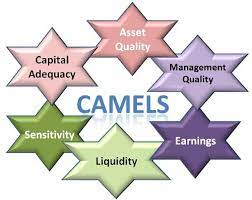
As we continue the analysis of the financial institution sector, it is pertinent to look at the other ratios in this aspect for analysing the financial service sector.
Next is the Asset Quality; the quality of assets is a significant aspect to assess the degree of the financial strength of a bank. It applies to the amount of existing and potential credit risk associated with the bank’s financial assets. Loans and investments in securities which are issued by other entities form the banks assets. The asset quality for loans, which are a significant bank asset, and depends on the borrowers’ creditworthiness and the corresponding adequacy of adjustments for expected loan losses. The banks’ loans are measured at amortized cost and are reported on the balance sheet net of allowances for loan losses.
The assets quality is important, where the value of assets can decrease rapidly if they are high risk. For example, loans are a type of asset that can become impaired if money is lent to a high-risk individual. Where a financial service has a trend of loss making on its major credit risk, this will affect its credit rating.
Management Capability
While analysing the management capability, it measures the ability of a financial services management team to identify and then react to financial stress. In this category which depends on the quality of a bank’s business strategy, the financial performance, and internal controls as well as the risk management are ways by which the management capability are considered as strong or weak. In the business strategy and financial performance area, the CAMELS examiner looks at the institution’s plans for the next few years. It includes the capital accumulation rate, growth rate, and identification of the major risks.
As for internal controls, the bank’s ability to track and identify potential risks is a threat. Also within the internal controls are the information systems, audit programs, and recordkeeping. Information systems ensure the integrity of computer systems to protect customer’s personal information. Audit programs check if the company’s policies are being followed. Lastly, record keeping should follow sound accounting principles and include documentation for ease of audits.
Earnings
On the aspect of the earnings, it helps to evaluate an institution’s long-term viability. A bank needs an appropriate return to be able to grow its operations and maintain its competitiveness. It looks at the stability of earnings, return on assets (ROA) , net interest margin (NIM), and future earnings prospects under harsh economic conditions. The core earnings are the long term and stable earnings of an institution that is affected by the expense of one-time items.
Liquidity Position
The bank’s liquidity is especially important, as the lack of liquid capital can lead to a bank collapse. This category of CAMELS examines the interest rate risk and liquidity risk. Interest rates affect the earnings from a bank’s capital markets business segment. If the exposure to interest rate risk is large, then the institution’s investment and loan portfolio value will be volatile. Liquidity risk is defined as the risk of not being able to meet present or future cash flow needs without affecting day-to-day operations.
Sensitivity to Market Risk
While we look at the last of the ratios of the CAMELS analysis, the sensitivity analysis which is a measure of an institution’s sensitivity to market risks. For example, assessment can be made on energy sector lending, medical lending, and agricultural lending. Sensitivity reflects the degree to which earnings are affected by interest rates, exchange rates, and commodity prices.
Interest rate risk is the key market risk that impacts a bank’s earnings. A bank’s interest rate risk is the result of differences in maturity, rates, and repricing frequency between the bank’s assets and its liabilities. It exposes the bank to interest rate risk. An increase in interest rates would increase the bank’s net interest income. This would occur because banks have more assets than liabilities. However, the terms of a bank’s assets and liabilities differ.
Banks adjust their balance sheets following opportunities presented in the market at any given time.
Limitations of the CAMELS Approach
The limitation to the CAMELS approach is prone to uncertainty, subjectivity, and inconsistency. There are situations where the analysis of the bank accounting records cannot determine appropriately and difficult to assign a score, for example, an average or below-average score. It is relatively easy to spot the good and bad indicators, not the in-betweens in its rating of say 1 to 5. However, when the bank analyst is forced to make a judgment, this is exposed to subjectivity. And besides, different analysts have differing levels of expectations and perspectives. In conclusion, the CAMELS approach has failed to recognize weaknesses in banks before a crisis.
#MMBA-4



