
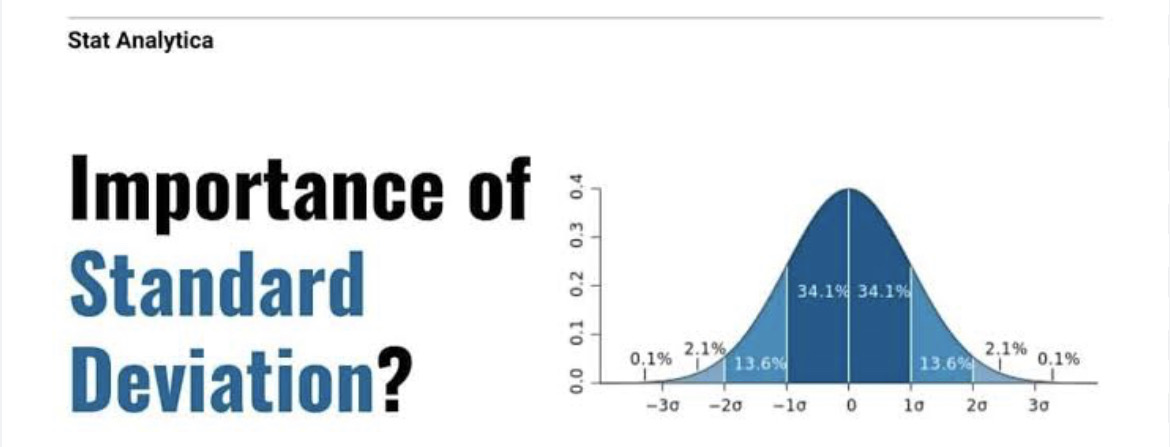
Standard deviation is a statistical measure that is commonly used in financial markets to measure the volatility of asset prices.
Volatility refers to the degree of variation of an asset’s price over time. In other words, it is a measure of how much an asset’s price fluctuates relative to its average price.
Standard deviation is a popular tool for measuring volatility because it can provide insight into the potential risks and rewards associated with investing in a particular asset or portfolio.
In financial markets, standard deviation is used in several ways. For example, it is commonly used to calculate the risk of a particular investment. A higher standard deviation indicates greater volatility, which means that the investment is riskier. Conversely, a lower standard deviation indicates lower volatility, which means that the investment is less risky.
Standard deviation is also used to compare the volatility of different investments. For example, an investor may want to compare the volatility of two stocks to determine which one is riskier. The stock with the higher standard deviation is generally considered to be riskier because it has a greater potential for price fluctuations.
Another way that standard deviation is used in the financial markets is in the calculation of returns. Returns refer to the percentage change in an asset’s price over a given period. Standard deviation is used to calculate the average return and the degree of variation of returns over time. This information can be useful in determining the risk and potential reward associated with a particular investment.
One of the key advantages of using standard deviation in financial analysis is that it provides a more comprehensive picture of risk than other measures of risk, such as beta or alpha. Beta measures the sensitivity of an asset’s price to changes in the overall market, while alpha measures an asset’s performance relative to a benchmark index. However, standard deviation provides a more detailed analysis of an asset’s volatility, which can help investors to better understand the risks and potential rewards associated with investing in that asset.
There are also some limitations to using standard deviation, in financial analysis. For example, standard deviation is based on historical data, which may not accurately predict future market movements. In addition, it assumes that the data is normally distributed, which may not always be the case. Therefore, it is important to use standard deviation in conjunction with other measures of risk to get a more accurate picture of an investment’s potential risks and rewards.
Overall, standard deviation is a useful tool for analyzing the volatility of asset prices in the financial markets. By providing a comprehensive picture of risk and potential reward, it can help investors make informed investment decisions. However, it is important to use standard deviation in conjunction with other measures of risk and to consider the limitations of the tool to get the most accurate analysis of an investment’s potential risks and rewards.




 AGRICULTURE IN THE NIGERIAN SPACE AND SOLVING A BUSINESS PROBLEM: INVESTING