
Linear programming is a mathematical optimization technique used to find the best solution to a problem with linear constraints. It is widely used in various fields such as business, engineering, and economics to solve resource allocation and optimization problems.
The basic idea of linear programming is to find the optimal values of a set of decision variables that maximize or minimize a linear objective function subject to linear constraints.
Decision variables are the variables that we are trying to determine, while the objective function represents the goal we are trying to achieve. The constraints are the limitations or requirements that must be satisfied.
The mathematical formulation of a linear programming problem can be written as follows:
Maximize (or Minimize) Z = c1x1 + c2x2 + … + cnxn
Subject to:
a11x1 + a12x2 + … + a1nxn <= b1
a21x1 + a22x2 + … + a2nxn <= b2
…
am1x1 + am2x2 + … + amnxn <= bm
x1, x2, …, xn >= 0
In this formulation, x1, x2, …, xn are the decision variables, c1, c2, …, cn are the coefficients of the objective function, aij are the coefficients of the constraints, and bi are the constants on the right-hand side of the constraints.
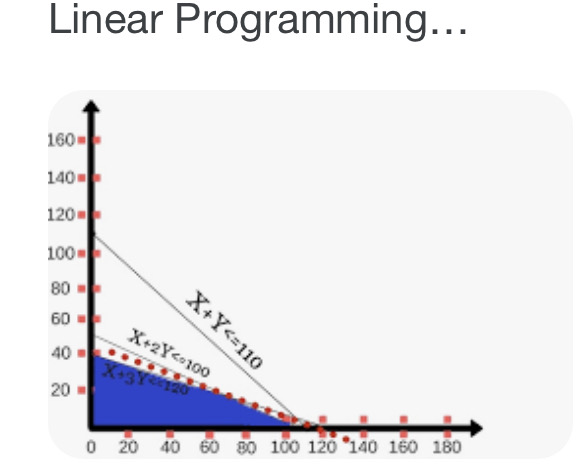
The constraints are linear inequalities that define the feasible region of the problem. The feasible region is the set of all possible combinations of the decision variables that satisfy all the constraints. The feasible region is typically a polytope, which is a geometric object defined by a set of linear inequalities.
The objective function is also a linear function that represents the quantity we are trying to optimize. If the objective is to maximize the function, we call it a maximization problem. If the objective is to minimize the function, we call it a minimization problem.
The solution to a linear programming problem can be found using a variety of algorithms. The most used algorithm is the simplex method, which iteratively moves from one vertex of the feasible region to another vertex until it reaches the optimal solution. Other algorithms include the interior-point method, the primal-dual method, and the network simplex method.
Linear programming has many practical applications. In business, it is used to optimize production processes, inventory management, transportation planning, and financial planning. In engineering, it is used to design optimal systems, such as electrical networks, water distribution systems, and traffic flow systems. In economics, it is used to model and analyze markets, trade, and pricing policies.
One of the major advantages of linear programming is its flexibility in handling complex problems. It can be used to solve problems with hundreds or even thousands of decision variables and constraints. Moreover, linear programming can be easily modified to include additional constraints or objectives.
However, linear programming also has some limitations. It assumes that the problem is linear and continuous, which means that the decision variables and objective functions must be linear functions, and the constraints must be linear inequalities. Additionally, linear programming assumes that the problem has a unique optimal solution, which may not always be the case.
In conclusion, linear programming is a powerful optimization technique that can be used to solve a wide range of resource allocation and optimization problems. Its flexibility and scalability make it a popular choice in many fields, while its limitations and assumptions must be taken into consideration when using it to solve practical problems.




 10 KEY LEARNING TERMS IN ACCOUNTING