
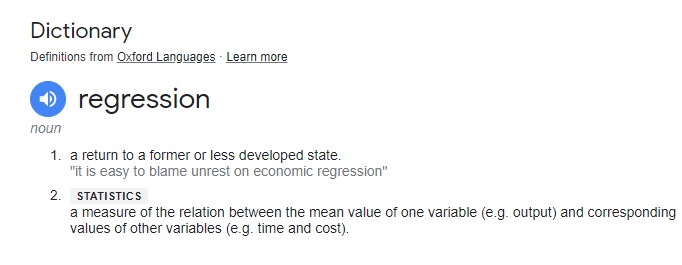
Regression, as a word means returning to a former state or some other people, will define put it as going backwards. Regression is one of those things we actively work against by investing in ourselves in the little way we can. However, in the world of data analytics, regression is a positive tool used to determine the impact of one variable on another. Regression analysis is a favourite when it comes to quantitative analysis.
Regression models are built using a dependent variable and an independent variable for a simple regression model and dependent and multiple independent variables for a multiple regression model. The variables require data to function in any given regression model. Regression models can be useful in financial analysis or business analysis. The model and the significance of the independent variable on the dependent variable will help business managers in decision-making, improvements and adjustments.
In my profession as a sales manager, I have thought of different applications of regression models and how they can be used to determine how different variables impact sales performance such as:
- Number of sales calls made by an account manager against sales performance
- Firm characteristics against sales performance
- Brand perception against sales performance
- Customer satisfaction and how it affects cross-selling and upselling
Building upon the data provided by the sales team which is inputted into the customer relationship management (CRM) tool, a regression analysis can be done using different variables. The analysis will help the management in making some decisions in line with the variables that are significant to sales performance.
In preparing for the data analytics examination, we were asked to get data for ten years from ten different banks in Nigeria and South Africa in advance. The topics issued differently to each individual were also assigned in advance to enable everyone to get the specific variable and data to run their regression analysis and then interpret it. The topics included variable firm characteristics, auditor characteristics, CEO characteristics, bank performance, cash liquidity risk, and capital adequacy risk. Getting the data required for these variables was not an easy task, a lot of my colleagues felt frustrated and overwhelmed by the task. In the end, we decided to outsource the data collection and got the data set required for our different topics within twenty-four hours.
For the examination, we were asked to run both simple regression models and multiple regression models based on our dataset based on our assigned topics. It was fairly easy to run the regression model due to practice, the challenge however was interpreting the results correctly. There was a struggle with explaining the coefficients; strong negative, strong positive and so on. Explaining the P-value of a regression model was easy. The P-value determines if the independent variable is statistically significant or not, a value less than 0.05 determines that. I gave the exam my best effort and I hope it reflects in my result. The result will be a reflection on my learning journey and hopefully, it’s a strong positive.




 REFLECTIONS ON THE INTERPLAY OF THE INTELLECT AND WILL ON THE SENSITIVE DIMENSIONS OF MAN