
Everyone should be able to use critical thinking, but not everyone does. It is the capacity to assess arguments, analyze information, and reach logical conclusions supported by facts and evidence. Because it empowers us to think independently and base our decisions on facts and evidence, critical thinking is crucial. We’ll discuss critical thinking in this blog article, including what it is, why it’s crucial, and how to develop your critical thinking abilities.
Critical thinking: What is it?
It is a mental process known as critical thinking to analyze, evaluate, and synthesize data in order to achieve well-informed decisions or conclusions. It entails challenging presumptions, weighing different viewpoints, and applying logic and reason to assess the facts.
Being skeptical or pessimistic is only one aspect of critical thinking; being objective and unbiased is another.
Exactly why is critical thinking crucial?
You may use critical thinking to your advantage in many aspects of your life, both personally and professionally. Here are several justifications for the significance of critical thinking:
Better decision-making: By assessing information and evidence with objectivity, critical thinking enables you to make better decisions. It permits you to take into account various viewpoints and come to a well-informed judgment based on information and proof.
Problem solving: The ability to think critically is necessary for problem solution. It lets you to pinpoint a problem’s underlying causes, investigate them, and develop workable remedies.
Effective communication: The ability to organize your thoughts, assess your arguments, and succinctly express your ideas are all skills that critical thinking gives you.
Career success: Employers place a high value on critical thinking, and those who have it are more likely to succeed in their jobs. You can use it to understand difficult issues, come to wise judgments, and interact with others in a productive way.
Personal development: By allowing you to have a better understanding of who you are and the world around you, critical thinking can also help you personally. It gives you the chance to question your beliefs, take into account different viewpoints, and gain a more subtle knowledge of difficult problems.
How to Develop Critical Thinking Capabilities
Improving your critical thinking skills requires practice and effort. Here are some strategies you can use to improve your critical thinking skills:
Question assumptions: Critical thinking requires you to question assumptions and consider alternative perspectives. Instead of accepting information at face value, ask questions and seek out evidence to support or refute claims.
Evaluate evidence: Critical thinking requires you to evaluate evidence objectively. Look for evidence that supports or contradicts a claim, and evaluate it based on its credibility, reliability, and relevance.
Consider multiple perspectives: Critical thinking requires you to consider multiple perspectives and viewpoints. Look for different viewpoints on an issue and evaluate them objectively
Seek out diverse perspectives: Critical thinking requires you to seek out diverse perspectives and consider them objectively. Look for different viewpoints on an issue and evaluate them based on their credibility and relevance.
Fig 1.0 A flow diagram depicting the process of critical thinking
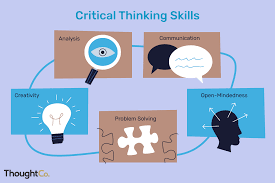
Critical thinking is an essential skill that enables us to analyze information, evaluate arguments, and make informed decisions based on facts and evidence. It is important for personal and professional success and can benefit us in many areas of our lives. Improving your critical thinking skills requires practice and effort, but it is a skill that can be developed and honed over time. By questioning assumptions, evaluating evidence, considering multiple perspectives, analyzing arguments, practicing logic and reasoning, and seeking out diverse perspectives, you can improve your critical thinking skills and become a more effective problem solver and decision maker.




 April 13 & 15 – Of Target Corporation and More Financial Ratios