
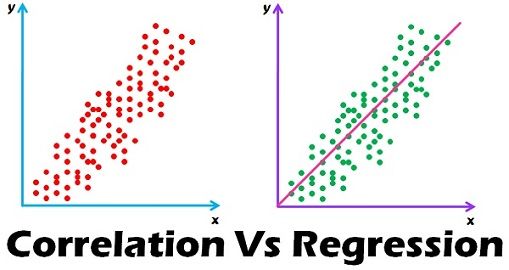
Correlation and regression are two commonly used statistical methods in data analysis. While both methods involve the relationship between two or more variables, there are some key differences between the two methods.
Correlation is a statistical method used to determine the degree of association between two or more variables. It measures the strength and the direction of the relationship between the variables. The correlation coefficient, represented by the letter “r”, shows the degree of association, with values ranging from -1 to 1. A correlation coefficient of -1 indicates a perfect negative correlation, meaning the variables move in opposite directions, whereas a correlation coefficient of 1 indicates a perfect positive correlation, meaning the variables move in the same direction. A correlation coefficient of 0 indicates no correlation between the variables.
Regression analysis, on the other hand, is a statistical method used to model the relationship between a dependent variable and one or more independent variables. It aims to find a function that best fits the data, allowing for predictions to be made for a given set of independent variables. Regression analysis yields an equation that can be used to predict future outcomes of the dependent variable.
One of the key differences between correlation and regression is their purpose. Correlation is used to establish whether or not there is a relationship between variables, and if so, the strength of that relationship. Regression, on the other hand, is used to predict future values of the dependent variable based on changes in the independent variables.
Another difference is in their assumptions. Correlation assumes that both variables are continuous and normal in distribution. Regression, on the other hand, assumes that there is a linear relationship between the variables, the independent variables are not correlated with each other, and the residuals are normally distributed.
A third difference is in their interpretation. Correlation measures the strength of the relationship between variables but does not indicate direction or cause-and-effect relationships. Regression analysis, on the other hand, allows for cause-and-effect relationships to be determined, as changes in the independent variables can be used to predict changes in the dependent variable.
While correlation and regression have their differences, they also share some similarities. Both methods involve the relationship between variables and use statistical techniques to measure that relationship. They can both be plotted on a scatter plot to visualize the relationship between the variables. Additionally, both methods are affected by outliers in the data. Outliers can have a significant impact on the results of both correlation and regression, and it is important to identify and address them appropriately.
To summarize, correlation and regression are two statistical methods used in data analysis to measure and assess relationships between variables. Correlation measures the strength and direction of association between two or more variables, while regression aims to predict future outcomes of a dependent variable based on changes in the independent variables. They differ in purpose, assumptions, and interpretation, but both are important tools in understanding and analyzing relationships in data.



