
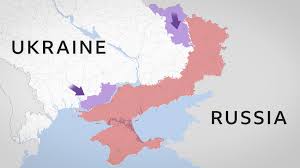
Russia is not winning its war in Ukraine. But it has regained the initiative. A couple of months ago, in the wake of the victories in Kharkiv and Kherson, I was hearing talk of Ukraine mounting a winter offensive, and then a spring offensive. Now, all the talk is of Russian winter and spring offensives.
It’s always hard to know what’s going on in the fog of war, but here’s the general picture that’s being painted by experts like Michael Kofman and Phillips O’Brien. Initially, Russia invaded Ukraine with many armored vehicles but not many troops — perhaps only 120,000 or 150,000. Ukraine turned out to be very good at destroying Russian armored vehicles — the U.S. estimates that Russia has now lost about half of its total tank force, which is huge. But Russia mobilized a huge number of men — fewer than it would like, and none of whom are very well-trained, but enough to reverse its manpower shortage. Now Russia is generally believed to have about 300,000 troops in Ukraine, with perhaps 200,000 more on the way. That’s a lot of guys.
With fewer armored vehicles but a lot more soldiers, Russia’s tactics have shifted in a pretty predictable way. They are sending a bunch of infantry forward, supported by artillery barrages — sort of a modernized World War 1. They aren’t able to provide as much artillery fire as before, thanks to Ukraine’s HIMARS missile launchers disrupting their logistics, and due to old Soviet ammo stockpiles running low. But they still have a lot, and Ukraine hasn’t managed to destroy a large percentage of the Russian artillery launchers. So between that, and a willingness to take very high casualties in what are essentially human wave attacks, Russia is wearing down Ukrainian defenses. The blunt fact is, although Ukraine’s army is more competent, Russia has four times as many people as Ukraine, and if a much larger country mobilizes its whole society toward the task of defeating a much smaller (and poorer) one, it is very hard for the smaller, poorer country to prevail without sustained outside help.
Hopefully, new Western aid packages that include Leopard tanks, longer-range glider missiles, etc. will turn the tide again. Hopefully, Russia won’t be willing to continue to sustain massive casualties. Hopefully, sanctions will weaken Russia’s economy to the point where it won’t be able to prosecute the war anymore. But long-term security doesn’t run on hope; it runs on a sustainable balance of power. And in the long run, the United States can’t be counted on to be a permanent Trump card against a Russia that has committed itself to an ideology and identity of expansion and imperialism. The only way Europe can ensure its own security is to unite and prepare itself to prevail in a long stand-off with the aggressive empire next door.
In order to stare down Russia over the next two or three decades, Europe must change this mindset completely. The invasion of Ukraine caused the region to unite politically around sanctions and military aid in a way that it hasn’t been united in its entire history. But this isn’t enough; Europe must unite to increase defense spending substantially and wean itself entirely off of Russian energy.
Increased military spending in Europe will allow it to build up the masses of high-tech missiles, drones, satellites, and other weapons that will be necessary to defend it against any future Russian incursions without calling on assistance from the United States. It will also allow Europe to take over support for Ukraine’s war effort in 2024 and beyond, should partisan infighting and/or a pivot to China weaken U.S. gifts of aid. To this end, Europe must also put aside petty internal squabbles. Brexit drove a deep wedge between the UK and the EU. Presenting a united front against Russia doesn’t mean forgetting about that disagreement, but the performative posturing and sniping over the dispute on both sides should be shelved.
#MMBA4




 Why Leaders Need to be Critical Thinkers