
#MMBA 4

Just after his normal comic entry, he started with his usual routing by asking what our take home from the last class after which was he introduced us to the new topic, analysis of financial statement. Professor Owolabi, a full time faculty at the prestigious Lagos business school, for me he’s not just a facilitator but a teacher , he took us through the rudiments of the topic by saying financial statement analysis is an important aspect of corporate financial accounting. In his words, it is the tearing apart of the financial statements and looking at the relationships. A more elaborate definition could be given as the analysis of a company’s component of financial statement such as its income statement, statement of financial position and statement of cash flow to shed light on the company’s financial health and performance.
He continued by mentioning that the analysis of financial statement is important to both internal and external users. For several reasons, it’s crucial that businesses analyze their financial statements regularly. Its primary benefit is that it aids executives in tracking financial performance over time, so facilitating the necessary course corrections. If a company’s income is falling, for instance, it may be time for executives to look for ways to trim the budget or forge on with the search for untapped markets. In other words, the management benefits from it by making informed decision about the organization, while external users like investors, creditors benefit from it as it serves as a tool in deciding if to invest in the organization or not or if existing investor should keep their investments.
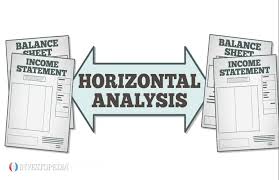
Analysis of financial statements can be done in several ways. Horizontal analysis, vertical analysis, common size, and trend percentage are some of the more typical approaches. Horizontal analysis is when you compare financial statements from different time periods. For example, you might compare the income statement from this year to the income statement from last year. Managers can use horizontal analysis to find trends and changes in how well their finances are doing over time. He called it moving from left to right and vice versa between two years financial statement of an organization. In vertical analysis, each line of a financial statement is shown as a percentage of a base line. On a balance sheet, for example, each asset would be shown as a percentage of all the assets. Vertical analysis can help managers figure out how different parts of a financial statement are put together.
In a Common Size Analysis, each line item is shown as a percentage of a common base. This is a type of vertical analysis. On an income statement, for example, each item of income and expense would be shown as a percentage of the total amount of income. Managers can use the common size analysis to compare the financial statements of different companies or different times.
Revenue increase over the last five years is one example of a financial statement item that may be analyzed using a method known as trend percentage analysis. Managers can use trend percentage analysis to see how financial performance has changed over time. Ratio Analysis is the process of calculating ratios like liquidity ratios (such as the current ratio), profitability ratios (such as the return on equity), and solvency ratios (such as the debt-to-equity ratio) using information from the financial statements (e.g. debt-to-equity ratio). Ratio analysis can help managers figure out how well a company is doing financially and how well it is doing overall. This is a quick recap of my last corporate financial accounting class , hoping to see professor Afolabi soonest .





 THE CHALLENGES THAT FACE START UP BUSINESSES IN NIGERIA