
From my last write up on the psychological traps in decision making and learnings from the ABP class, I had called out to us as leaders, to become more conscious of our mental processes and make better, more informed choices by identifying these biases.
In this post, I will dwell on transforming our Framing Bias to Framing Effect, and how, as leaders, we should consciously use the framing effect to affect the decisions of others, helping them reach positive outcomes.
A framing bias is when people make decisions based on how information is presented or framed, rather than on the information itself. On the other hand, a framing effect is where people’s preferences or choices are influenced by the way information is presented.
Both framing bias and framing effect have their advantages and disadvantages when it comes to making business decisions. Depending on the circumstance and its application, both might have favourable or unfavourable outcomes. By favouring one perspective or result over another when presenting information, framing bias can result in poor decision-making that are based on inaccurate or biased information. By presenting information in a way that emphasizes the advantages of a specific product or policy, on the other hand, framing effect may be utilized to positively influence individuals. This can help individuals make more informed decisions and can lead to positive outcomes.
A soft drink company may advertise their product as “sugar-free” in order to appeal to health-conscious consumers, but they may overlook the fact that the drink still contains artificial sweeteners, which can be harmful to health. This is a framing bias that deprives the consumer of all relevant information about the product.
Positively framing a product’s benefits can have an impact on consumer perceptions and purchase decisions when used in product marketing. The marketing might be presented in terms of how the product will improve the customer’s life or address a specific issue rather than concentrating on the product’s characteristics or specifications. For example, a weight loss product can be framed as a way to improve overall health and wellbeing, rather than simply as a means to lose weight. This framing effect can create a more positive association with the product and can lead to increased sales and customer loyalty.
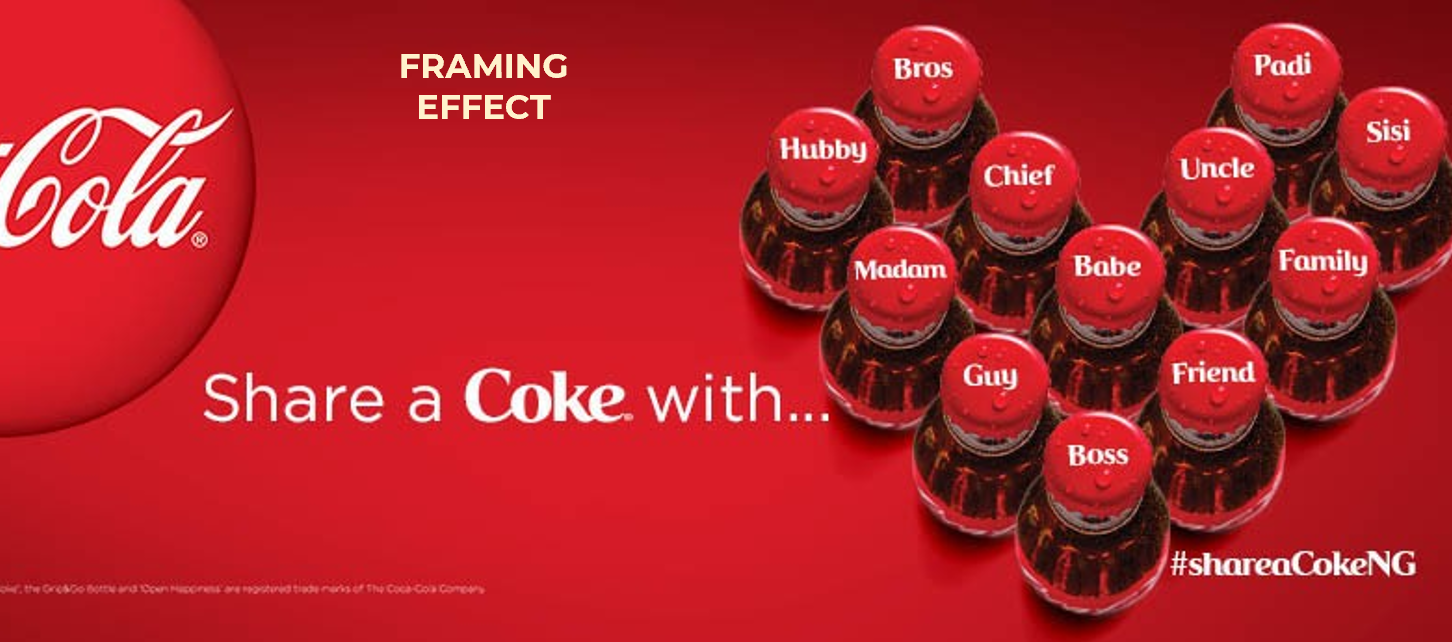
A classic example of a successful use of the framing effect is the “Share a Coke” campaign advert, launched by Coca-Cola.
The campaign involved personalizing Coke bottles and cans with people’s names and encouraging customers to share a Coke with someone whose name was on the bottle. “Share a Coke” campaign positioned Coca-Cola as a brand that was not just about refreshing beverages, but also about creating connections and spreading happiness.
Because it connected with Nigeria’s traditional values of community and sharing, the “Share a Coke” campaign had a positive framing effect there. The campaign used prominent Nigerian names, as well as local nicknames and words of endearment on Coke bottles and cans. The commercial promoted social interaction and the sharing of happy moments by framing it around drinking a Coke with someone who has a customized bottle. This framing effect resonated with Nigerians, who value the act of sharing and see it as a way to build and strengthen relationships with others.
Coca-Cola Nigeria reported a double-digit boost in sales over the campaign period, indicating that the campaign enhanced engagement and sales. The campaign generated significant buzz on social media, with customers sharing pictures of themselves and their friends holding their personalized bottles.
In conclusion, it is important to recognize when framing bias or framing effect are being used and to critically evaluate the information being presented. This can help the recipients of the ‘Framing’ make informed decisions that are based on accurate and unbiased information.
htuR #EMBA28




 The Power of Community