
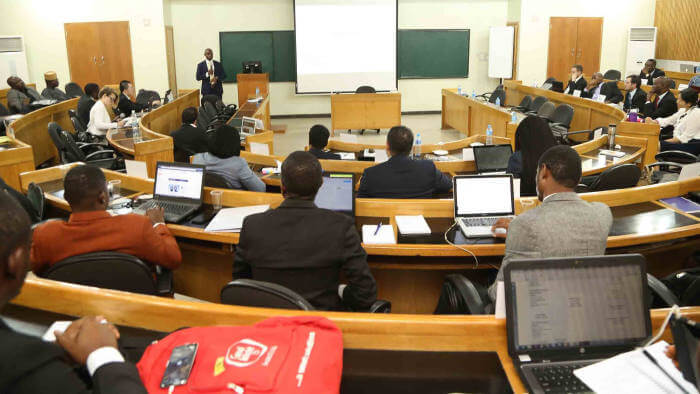
The first semester is almost over, preparations for the final exams are now the focus of everyone. The dates of exams were set on 14th (CFA and MC) and 15th (DA and ABP) of April. Our facilitators are guiding us on the essentials to ensure that we are all ready.
On Friday 31st of March, we submitted our CFA group assignment for the analysis of two companies’ financial statements (Ardova and Eterna specialized in the oil and gas industry) for a period of 10 years. This exercise took us around two weeks to be completed. Our group members collaborated together day and night for the successful outcome. Special thanks to our accounting teams in the group who assist everyone to be on the same page with regards all the technicalities and deep analysis of the financial statements. The aim of this analysis is to propose recommendations for the management to improve their performance and to advise the possible shareholders on the appropriateness of Investing in Ardova.
We used various ratio analysis such as liquidity, gearing and profitability ratios. Details and explanations of those ratios can be found in one of my previous blogs “Mehrez El Bitar. (2023). The Roadmap: Financial Statement. [Online]. African musings. Last Updated: 19 Mar 2023. Available at: https://africanmusings.com/wp-admin/post.php?post=17367&action=edit [Accessed 2 April 2023]”.
Jumping to another quantitative course (DA). On Saturday 1st of April, we had our first physical class with Dr. Francis Okoye. The class was so much interactive, as usual, with a lot of questions towards the possible questions in the exam. We did two sessions on the revisions of major data analytics problems’ solving. Examples / exercises were solved in-class in order to illustrate the chapters. The main focus was on the below points:
- Definition of probability, relative frequency and sample space.
- The fundamental rules of independent and intersection.
- Bayes’ theorem with real example on the conditional probability of an event related to the occurrence of another event. Starting with prior and conditional probabilities to calculate the joint and posterior (revised probability).
- Types of probability distributions:
- Discrete (Binomial; two possible outcomes). Once the content is understood, excel will do the work.
- Continuous (uniform and normal distributions). Simple and straight forward formula, it was clearly explained with a real-life example (probability of a flight delay).
Analysis of Business Problems (decision making) is a combination of listed courses given during the 1st semester. Each case has its own peculiarities driven by the data given in each case. There is no way a case can be analyzed without using Management Communication combined with either CFA or DA in addition to the context analysis (qualitative). This wrap-up session merged all previous learning about how to approach each case without being biased and anchored in our analysis. Traps within the case will be the most serious part to detect. From the context, we have to phrase the objective(s) and clearly identify the problem Irrespective of our recommendations and action plans for the case, it is mandatory to analyze all alternatives (pros and cons) within the case using the criteria (checklist) for proper evaluation. Giving an example for clarity and distinguish between the steps:
- Objective: finding a job
- Alternative: Companies’ names, sectors
- Criteria: salaries, position, benefits
While everyone should seriously get prepared individually for the exams, I believe that group discussions and revisions will ensure that everyone get aligned and pass.




 The Synergy of Artificial Intelligence and Data Analytics: Empowering the Digital Age