
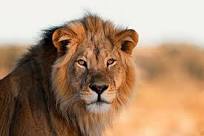
One of my past time interests is reading stories on Quora the popular social media question-and-answer website site. In one such reading, a writer wrote a very sobering piece about the life of a male Lion, here is the piece.
I’ll tell you just one that completely took me by surprise because practically nobody thinks of it. It is about how terribly stressed and downright cruel the life of a male lion is.
The male African lion is the king of the plains (no, not of the ‘jungle’, that would be the tiger). It is easily the largest and strongest of the big cats in Africa. And is often portrayed as having a regal and very comfortable lifestyle with lionesses doing most of the hunting, while the male/s of the pride get to then eat first!
All of that is true – so long as the lion has his pride. Most of them don’t.
It’s simply a matter of numbers. If every male lion with pride has said five lionesses, naturally there are a whole lot of males who have none and are on their own to hunt and try and dislodge other males from their pride. Just one in eight male lions will even survive to adulthood.
Also consider the fact that lions (i.e., Lionesses) hunt by a combination of two methods – Coordinated attacks – like a couple of lionesses driving a herd of wildebeests into a narrow pass and then another couple first picking off and then finishing one of the preys. Ambush – this is much harder to do on the plains because there is little cover unlike say for a tiger in a thick forest.
Now given its sheer bulk and thick mane, it is hard for a male lion to hide. It can run faster than say a tiger but doesn’t have anything close to the sheer speed of cheetahs in terms of all-out chase or the incredible stamina of an African wild dog or hyena to pursue its prey endlessly until the latter collapses from exhaustion.
As a side note in terms of contrast, cheetahs have a stunning ‘hunt: kill’ ratio – almost one in two hunts succeed, but the challenge then for them is to hold on to what they’ve killed. And unlike a lion, given their blinding speed, they simply pick a target that’s within a few dozen meters and go flat out in complete view.
Back to the topic, there is a solid reason why the primary role of a male lion in a pride is to protect the females and the cubs that he has sired, both from other rival competitive predators (most notably hyenas that are the primordial and chief enemy) and other male lions (who will instantly kill all the cubs if they take over). On the rare occasion, a male lion will be decisive in bringing down massive prey like an old Cape buffalo but that’s quite uncommon.
But male lions are so stressed out that the lifespan of lionesses is some four years more than theirs. When you’re talking about a species that only lives as long as a dog for 12–15 years, is a big deal.
Compare this now to the average lifespan of the two most common and favourite prey of lions – Wildebeests at 20 years, Zebras at 20–30 years, yes, multiple years longer than their predators.
Worse still unlike prey, predators like lions cannot simply get up and leave if there’s a drought. Because other grounds already belong to other male lions and as a species, they are incredibly territorial. So yeah, in an especially bad dry season, if the prey leaves in search of better pastures, the lion simply does not have that option. This is something very important that most people fail to realise when looking at predator vs. prey.
It is not a stretch to say that on balance, the male lion has the most stressed-out lifestyle of all large animals on the plains (except cheetahs).
A king who lives significantly shorter than the females of his species and way shorter than even his prey. And is so crazy stressed out even in the best phase that male lions often won’t even eat or sleep at ease or comfortably.
Oh, but it gets even worse. How do they meet their end?
Starvation after being dislodged from their pride (if they even have one, to begin with). An old lion who has been dethroned has little capacity to hunt for himself. Being mauled to death by a younger and healthier male competitor who challenges them and takes over their pride.
Male lions on average control a pride for no more than four to five years during their life. Once again, that’s the successful ones.
As cubs after they’ve grown, are driven out of the pride they were born into after two to three years (unlike lionesses because young males could be a threat to their father), then if they’re lucky they’ll have a pride of their own for four to five years on average.
And then driven into the wilderness to meet a comparatively slow and miserable end. Do you know the irony of it all? It’s that the very distinguishing characteristic of lions as the only big cat that is social now proves to be a death knell – when isolated, it’s certain. Because, unlike a tiger or leopard, a lion struggles to bring down prey on its own.
Once an old lion is driven from the pride into a solitary existence, that advantage of being a social hunter becomes a mortal curse.




 The Father’s Love