
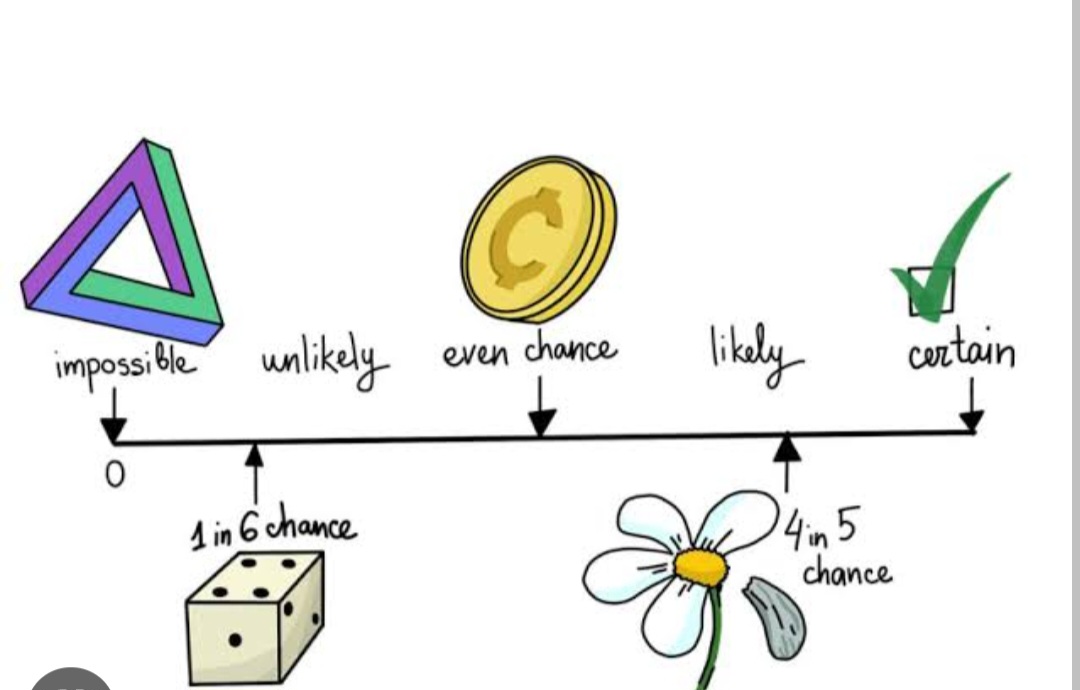
Probability is the measure of how likely any given random event is to occur. This was the best junior high school definition of probability since it used the common examples of tossing a coin or rolling a die, which everyone understood in words but not in mathematics.
After two weeks of the Data Analytics course, we started studying probability and its ideas, which were all known to us because we had briefly discussed it in junior high. The mathematics seemed complicated, but it wasn’t rocket science. We however understood that our behaviors, decisions, and preferences are influenced by the probability of an event occurring, which is also known as the possibility of an event occurring.
The probability that a random event will occur when computed mathematically tilts towards one (1), and its probability of not occurring tilts towards zero, this follows that Probability spans from zero (0) to one (1). It is represented mathematically as follows:
P(A) = P(A)/P(A+B + C)
This example demonstrates the conventional method of assigning probabilities: the probability of A occurring is calculated as a ratio of A divided by all feasible outcomes (A + B + C).
Three main methods can be used to determine the probability of any event: the classical method, the relative frequency method, and the subjective method. Each of the three methods uses a different formula to assign a probability, which occasionally yields different results.
The classical method of probability posits that, like in the instance of tossing a coin, there is a possibility that all potential events will occur equally. The probability of tossing the coin in either the head or the tail at any given moment is 1/2. In contrast, the relative frequency approach assigns a probability to events by conducting experiments or using historical data; in other words, actual experiments are conducted to determine the potential outcomes of any event.
The most unscientific method of calculating probability is the subjective method, which bases calculations on opinions and/or personal experiences. It is based on an individual’s level of belief in the likelihood of certain occurrences occurring, this technique assigns probabilities to likely events.
However, as each method has uses in daily life, there is no technique that is superior to the others. Aside from these techniques for determining probabilities, other terminologies to be aware of in comprehending the notion of probability include sample points, sample space, experiments, compliments, events, the intersection of events, the union of events, Independent events, Mutually exclusive events, the addition law, Multiplication law, Prior Probability, Conditional Probability, Posterior Probability, Bayes Theorem, and, of course, the Venn diagram. The subsequent probability articles will examine these concepts and how they apply.
Weather forecasting, management decision-making, politics, agriculture, and many more fields employ the use of probability. In boardrooms and commercial markets, decisions must always be made and potential outcomes must be anticipated. So, in order to choose or make better life outcomes, it is necessary to learn and apply the concept of probability, with or without mathematics.



