
Thanks to Professor Bango, for taking out his time to teach us this concept of probability, Bayes theorem. Growing up as toddler, I have been learning probability rules, principles, laws, and theorems, right from secondary school to the university, and even in professional classes, but I learned the theorem of probability for the first time in Lagos Business School (LBS). It is simple and enlightening.
After the session, I had to further search for more information about Bayes theorem. I understand that, the theorem was discovered by British mathematician Thomas Bayes in the 18th century. It describes the probability of an event based on the prior knowledge (Prior probability) of condition that might be related to the event (conditional probability). So, with the given additional information, a revised probability (posterior probability) can be generated.
According to Bango, “Bayes’ theorem provides the means for revising the Prior probabilities”. Therefore, the total probability {Posterior) must be equal to 1.
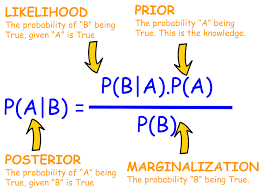
Bayes’ theorem is a fundamental concept in probability theory that provides a way to update our beliefs about an event based on new evidence or Information.
Where P(A|B) is the posterior probability of the event given the evidence, P(B|A) is the probability of the evidence given the event, P(A) is the prior probability of the event, and P(B) is the probability of the evidence.
However, Posterior probability can be calculated using formula, and can be computed in a tabular approach as thus:
| Prior Probability | New Information | Application of Bayes’ Theorem | Posterior Probabilities |
- Prior probability refers to the probability of an event before any new information is taken into account. It is often based on previous experience, historical data, or theoretical knowledge. The prior probability is denoted by P(A), where A is an event.
- Conditional probability refers to the probability of an event given that another event has occurred. It is denoted by P(A|B), where A and B are events, and P(A|B) is read as “the probability of A given B.” For example, the conditional probability of rain (A) given that the sky is cloudy (B) is denoted by P(rain|cloudy).
- Application of Bayes’ theorem: we use multifaction laws, by multiplying the prior probability with the conditional probability to get “joint probability”. Joint probability is the intersections between the two probabilities ( prior and conditional). It is denoted by P(AnB).
- Posterior probability refers to the updated probability of an event after new information is taken into account. It is calculated using Bayes’ theorem, which relates the prior probability, conditional probability, and posterior probability. The posterior probability is denoted by P(A|B), where A and B are events, and P(A|B) is read as “the probability of A given that B has occurred.” It is calculated as follows:
In conclusion, Bayes’ theorem is a powerful tool for updating our beliefs about an event or hypothesis based on new evidence or Information. It is used in many fields, including medicine, finance, and engineering, to make predictions and decisions based on uncertain information. By understanding Bayes’ theorem, we can make better-informed decisions and improve our understanding of the world around us.




 Analysis of Business Problems (Movie Review: Eye in the Sky)