
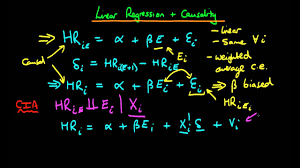
As a continuation of my learnings from the Data Analytics class, we also discussed the Correlation & Regression statistical methods.
Correlation and regression analysis are statistical methods used to investigate the relationship between two or more variables.
Correlation analysis is a statistical method used to measure the degree of association between two or more variables. The result of correlation analysis is a correlation coefficient, which ranges from -1 to 1. A correlation coefficient of -1 indicates a perfect negative/weak correlation, while a coefficient of 1 indicates a perfect positive/strong correlation. A coefficient of 0 indicates no correlation between the variables.
Correlation analysis can be used to investigate the relationship between two variables, such as the relationship between price and quantity. For example:
- If Price increases and Quantity demanded decreases, this indicates a negative/inverse or indirect relationship
- If Price decreases and Quantity demanded decreases and vice versa, this indicates a positive/direct relationship
Below are some limitations of correlation analysis;
- It doesn’t differentiate between the dependent and independent variables of an equation-n
- A high correlation can be by mere chance as there may be no logical connection between the variables concerned. This situation can also be referred to as a SPURIOUS correlation.
- You cannot use correlation to predict or forecast. Thus, it is advisable not to take the result of a correlation too seriously but on the direction.
- Correlation does not imply causation. It only informs on DIRECTION
It is safe to say that the Regression Analysis resulted from the limitation of the Correlation Analysis and can achieve the following:
- Relationship
- Cause & Effect (impact)
- Forecasting/Predictions
Regression analysis is a statistical method used to investigate the relationship between one dependent variable and one or more independent variables. The result of regression analysis is a mathematical equation that can be used to predict the value of the dependent variable based on the value of the independent variable(s).
Regression analysis can be used to investigate the relationship between a dependent variable and one independent variable. Regression analysis can also be used to investigate the relationship between a dependent variable and multiple independent variables, such as the relationship between education, income, and job satisfaction.
As with correlation analysis, regression analysis does not prove causation. Rather, it is used to predict the value of a dependent variable based on the value of independent variables. The prediction is based on the assumption that there is a linear relationship between the variables involved.
In conclusion, correlation and regression analysis are powerful statistical methods used to investigate the relationship between two or more variables. These methods are widely used in various fields and can provide valuable insights into the relationship between variables. However, it is important to remember that correlation does not imply causation, and regression analysis does not prove causation. When interpreting the results of these methods, it is important to consider other factors that may be influencing the relationship between variables.




 Corporate Financial Accounting Vs Other Disciplines – Numbing the nuances 5