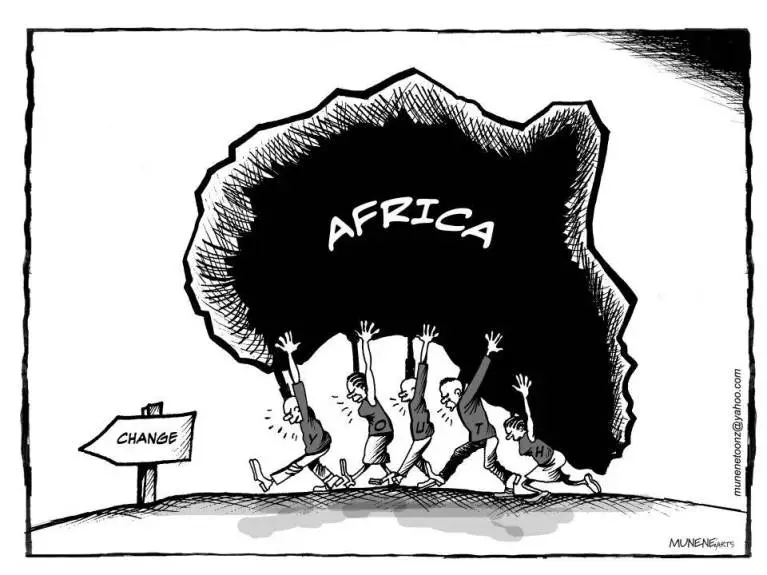
The New Partnership for Africa’s Development (NEPAD) is an initiative geared towards addressing the development problems that has plagued African states over the centuries.
The primary objectives of NEPAD can be categorized into four, which are: Eradication of poverty, promotion of sustainable growth and development among African states, integration of Africa states in the world economy, and acceleration of empowerment of women. Also, by extension, NEPAD’s other objectives was based on underlying principles of a commitment to good governance, democracy, human rights, conflict resolution and the recognition that maintenance of these standards is fundamental to the creation of an environment conducive to investment and long-term economic growth. NEPAD seeks to attract increased investment, capital flows and funding, providing an African-owned framework for development as the foundation for partnership at regional and international levels.
Emergence of NEPAD
The concern to have a broad-based approach to Africa’s development challenges was initiated by heads of five African states; South Africa, Algeria, Egypt, Nigeria and Senegal, hence the emergence of NEPAD. The strategic framework of NEPAD was thereafter adopted by the Assembly of African Heads of State and Government in the 37th Summit of the Organisation of African Unity (OAU) in July 2001.
However, the emergence of NEPA is hinged on three previous initiatives designed to address the complex challenges to growth faced by African states: the Millennium Africa Recovery Plan (MAP), led by former South African President Thabo Mbeki; the Omega Plan, developed by the former President of Senegal, Abdoulaye Wade; and the New African Initiative (NAI), which combined the first two initiatives. In 2001, in Lusaka, Zambia, these initiative assumed different dimension, the tenets were redesigned in line with the current realities of African states and expanded to provide a framework for all African states,
It is therefore imperative to wonder why previous developmental initiatives by African Leaders seems not effective in addressing numerous challenges confronting Africa states. Since NEPAD is an offshoot of previous initiatives, the probability that the initiative will hit brick walls like others is high.
Since its emergence in 2001, NEPAD has also faced formidable challenges that prevented it in actualizing the purpose and objectives for which it was created. Challenges like;
- Forging new partnerships among member states and western counterparts,
- Dismantling trade barriers among member states and western states
- Prevalent of political instability and dictatorships in African states,
- Overwhelming foreign intervention and the influence of policies
- Lack of commitment and cooperation by African leaders
- Poor investment in human resources and infrastructural development
- Emergence of insurgencies and militia groups spreading among member states
- Over reliance on western donations and aids etc.
Ideologically, NEPAD also faced challenges from civil society groups i,e anti-globalisation society, human right activist, labour unions etc. because it was perceived as promoting the interest of the west due to its ideological rationale.
Amidst all these internal and external challenges, it became obvious that this laudable African initiative is set to fail in the fulfillment of pivoting African states to achieving development. With persistence poverty, insecurity, economic instability, diseases, poor infrastructures, subjugating western influence etc. is there any light in the tunnel for African states?…. Does African states require to birth a new initiative that would be home-grown, devoid of any external influence? These are fundamental questions that would be answered in the subsequent post.
Thank you