

I remember when I was getting ready to write my entrance exam to the MBA course, a nice gentleman (staff of the LBS), I had met when I came visiting the school a couple of weeks prior (Brian) had told me “It would be easy, once you know how to compute mean, median and average”. Somehow, I passed the exam and I said to myself, “Ruth, it’s going to be an easy one indeed.”
However, my first encounter with Data Analytics had me bewildered. How is it even possible that this is what Brian said would be a walk in the park? Prof. Bongo Adi tried to explain all the types of probabilities, the frequencies, the f(x), the Ef(x), x-µ, (x-µ)^2, (x-µ)^2Xf(x) amongst others. I had a bad headache after the class and wondered how I would move forward. How is a lawyer like me expected to grasp all these formulars with the speed of lightening? Thanks to my #EMBA28 group 2 members who took the time, during our weekly review session, to explain how the formulars were to be applied. I am grateful for each of you, my Most Valuable Persons.
My interest is in the Bayes Theorem on conditional probabilities. Prof Adi dissected the theory using the tree concept showing the movements from prior probabilities and how from there we derive our posterior probability.
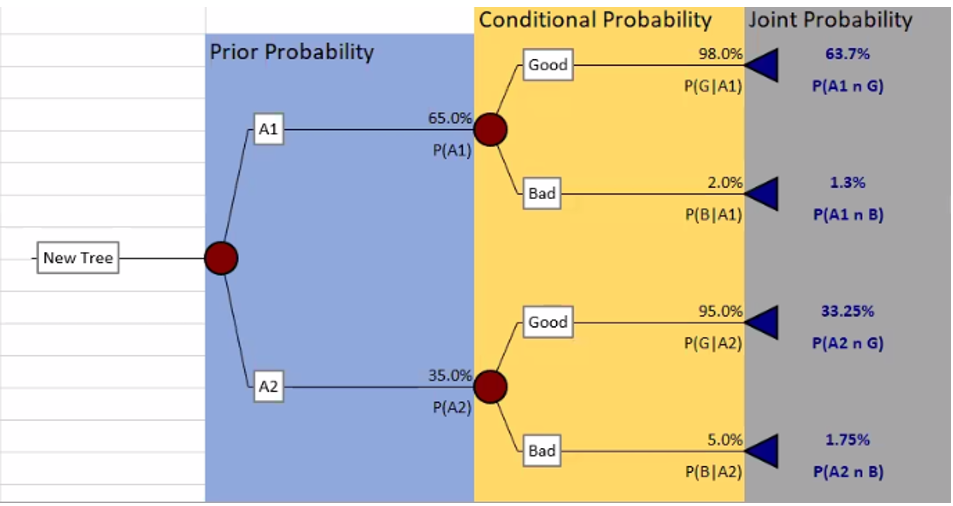
My interpretation and learning from the theory are that the business environment (even personal) is never statistic. Decision as made based on information currently available to decision makers per time. It is therefore important that as soon as new conditions (variables as I prefer to call them) become apparent which are different from the basis for the previous decision, impact of the new condition need to be thoroughly reviewed and a new decision need, if need be.
The old decisions become the prior probability, while the new information brings on board the new condition for determination. Given that the information provided are probabilities, the convention is to derive a joint probability from which a new set of probabilities are drawn (posterior probability) and compared with the first decision made to know if the business direction earlier taken is still on track.
Now I understand why businesses, especially the big corporations, even when they have drawn up on Annual plan which usually is done a couple of months before a new financial year, undertake monthly reviews of the projections (called Latest Estimates [LE]), which include an analysis of the market environment and dynamics checking what new information may impact their projections. Now I can clearly relate these monthly or quarterly review sessions to the Bayes Thoerem.
Lastly, data is king, and probability thrive on numbers. While a few others and I in our class continue to find ways to grasp all the probability theories in the Data Analytics course for this semester, I wish us luck as we delve deeper into the world of data and the probabilities they come with.




 Analysis and Instincts