
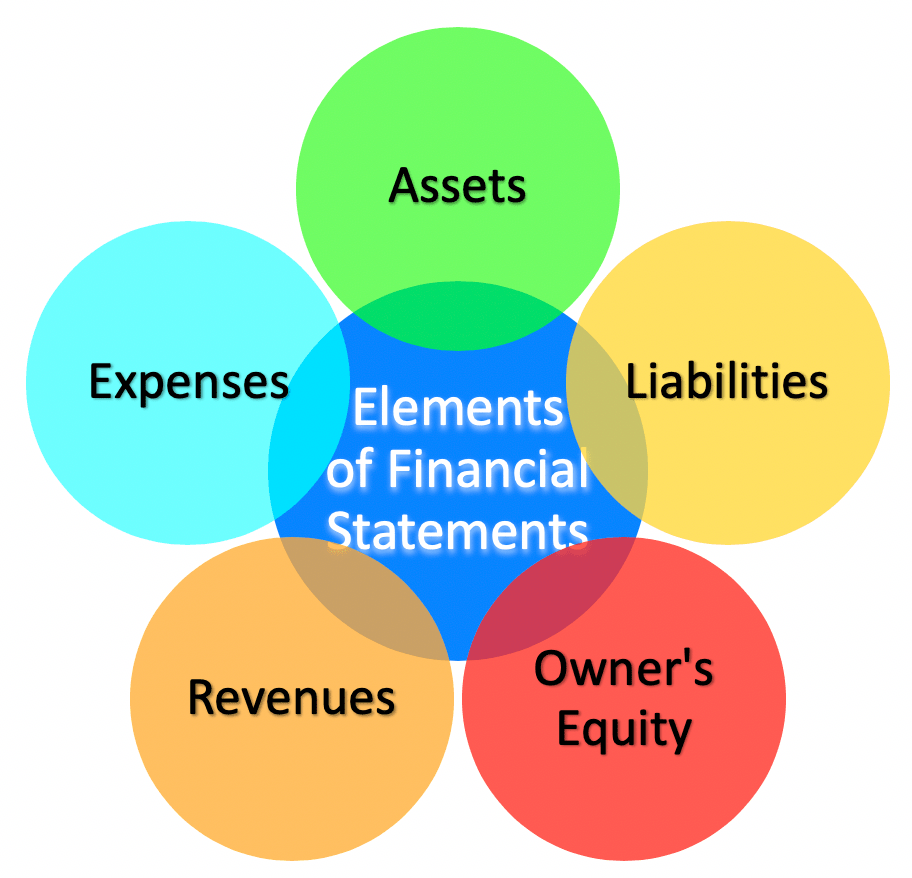
The elements of a financial statement are gotten from the Statement of Financial Position and the Statement of Profit or Loss. The elements are; Revenue, Expenses, Assets, Liabilities, and Owners equity.
ASSETS
An asset is a resource with monetary value that an organization, owns or controls with the expectation of future benefit. A company’s assets are reported on its balance sheet. They are divided into four categories: current, fixed, financial, and intangible. They are purchased or created in order to increase the value of a company or to benefit its operations An asset is anything that can generate cash flow, reduce expenses, or increase sales in the future, whether it’s manufacturing equipment or a patent.
TYPES OF ASSETS
- Non-current (Fixed asset) asset: – Fixed assets are resources that have a life expectancy of more than a year, such as plants, equipment, and buildings. As fixed assets age, an accounting adjustment known as depreciation is made. It distributes the asset’s cost over time. Depreciation may or may not reflect the loss of earning power of the fixed asset.
- Current assets: – Current assets are short-term economic resources that will be converted to cash or consumed within a year. Cash and cash equivalents, accounts receivable, inventory, and various prepaid expenses are examples of current assets. While cash is simple to value, accountants must reassess the recoverability of inventory and accounts receivable regularly. A receivable will be classified as impaired if there is evidence that it may be uncollectible. Companies may also write off inventory if it becomes obsolete.
LIABILITIES
A liability is a debt that a person or business has, typically in the form of money. Through the transmission of economic benefits like money, products, or services, liabilities are eventually satisfied. The two forms of liabilities are current liabilities and non-current liabilities.
The term “current liabilities” refers to debts that are due to be paid off within a year of the reporting date. For instance, because they are scheduled to pay an employee in the following month, the salary payable is categorized as current obligations.
Liabilities with a settlement date of more than one year are referred to as non-current liabilities. For instance, a bank loan with a term of installments longer than 12 months is categorized as a non-current liability. The balance sheet is the only place where liabilities data are kept, and they are the second component of financial statements.
OWNER’S EQUITY
This is the entity’s remaining ownership stake in its assets after all of its liabilities have been paid. Retained Earnings and Ordinary Share Capital are two excellent examples of equity. Accordingly, equity can rise or fall based on how assets and liabilities change.
Equities will rise, for instance, if assets are growing and liabilities are staying the same. The equity will, however, decline if the assets remain constant while the obligations rise.
REVENUE
Revenue is the money made from regular business operations and is calculated by multiplying the average sales price by the number of units sold. To calculate net income, costs must be deducted from the top-line (or gross income) figure. Sales is another name for revenue.
Profits from the sale of goods or the provision of services, interest from bank deposits, and dividends from equity investments are a few examples of revenues. Revenues are recorded and recognized in the income statement using two accounting standards. It employs two different bases: an accrual basis and a cash basis.
Revenues or income based on the cash basis are recorded when cash is received or collected. Contrarily, when risks and rewards are transferred from sellers to purchasers, revenue or income is recognized on an accrual basis. The buyer receives ownership of the goods or services from the seller.
EXPENSES
An expense is a cost that businesses incur in running their operations. Expenses include wages, salaries, maintenance, rent, and depreciation. Expenses are deducted from revenue to arrive at profits or losses.
Operating costs are those associated with a business’s core operations, including the cost of goods sold, administrative costs, office supplies, direct labor, and rent. These are the out-of-pocket costs associated with regular, everyday activities.
Non-operating expenses have no direct bearing on the primary activities of the company. Examples frequently given are interest fees and other fees related to borrowing money. These are costs that don’t relate to a business’s regular operations. These expenses might be from reorganizing or restructuring, paying interest on debt, or dealing with outmoded inventories.



