
Operations Management (OPM) is a study I have earnestly looked forward to because I believe it forms the foundation of any process or decision making at work, business and in life.
You can see operations in its simplest form in our daily activities – from the food we cook in the kitchen to the process of a girl getting her hair braided. Operations is a process.
Operations management helps managers address the operational and supply chain management to build value creation between a company’s processes and that of their customers and suppliers.
These are the benefits of effective operations management.
- It equips managers with the analytical skills, tools, and techniques to manage productive resources
- It involves the design and processes used for the optimal use of resources, raw materials, human capital, information, and other resources required in creating and delivery of a product and service to a customer
- OPM gives managers the tools to diagnose and solve operations problems in an efficient and effective manner
There are various aspects of operations management. Our highlights will be based on competitive priorities in operations management.
The purpose of competitive priorities is to position an organization at an advantage among its competitors.
In operations management, competitive priorities provide an organization with strategic focus on capabilities around technology, production processes, planning, control, and other aspects.
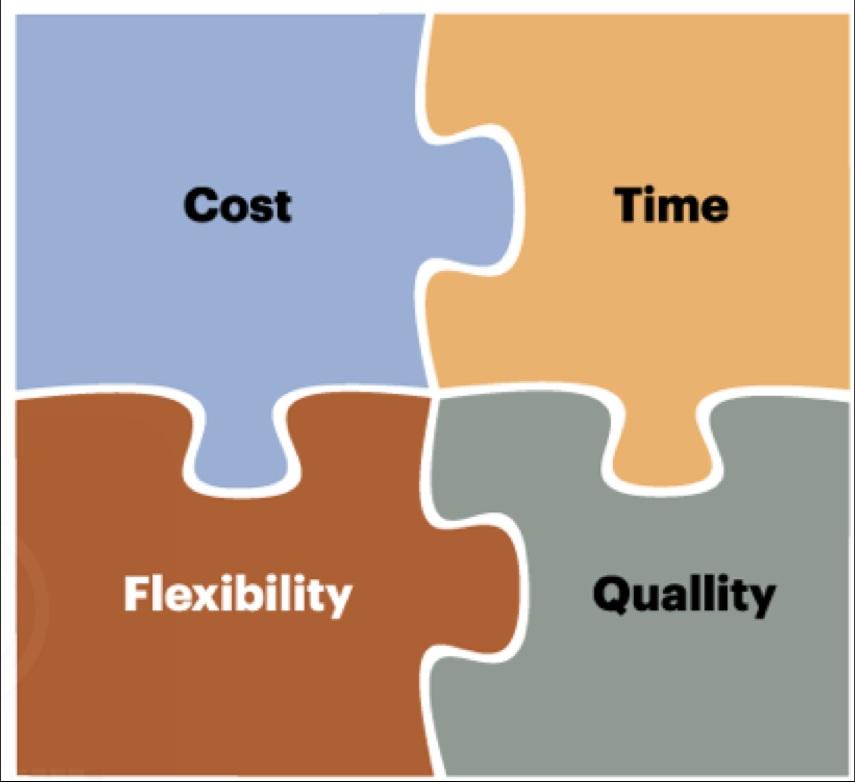
Competitive priorities are focused on cost, quality, flexibility, and time.
In translating priorities into design, an organization would conduct a market analysis to determine its strength in the market, and the depth of its competitive priorities.
| Competitive Priority | Manufacturing Implications |
| Cost | Low-cost production Monitoring costs across the different products Effective distribution of costs across the different products |
| Quality | Consistent quality Making sure that the products comply with industry standards and regulations Ensuring the process performs and complies with specification |
| Flexibility | Capability to manage volume changes Capabilities to manage product mix variations Ability to upscale or update equipment and the requisite trainings to implement these updates effectively Adaptabilities around workforce-related changes Customization of products or services Volume flexibility / adaptability to market, socio, and economics trend Differentiation / diversity of products |
| Time | Delivery performance: reliable and quick delivery of goods Availability of stock and raw materials Innovation: Time-to-market How quickly new products or processes can be implemented Development speed |
Many argue that flexibility is the most important competitive priority.
“Customer satisfaction can be obtained by adopting flexible capacity into the production, process, and timely supply. Delivery time or speed is considered an important competitive weapon. Organizations today compete for delivering a better quality of products/ services in a shorter time as much as possible.
So, we can say that this competitive priority’s focus is on speed – fast delivery and timely delivery. Fast delivery is receiving orders in a much quicker way. On-time or timely delivery is related to the number of times deliveries are done at a given time. One more weapon is development speed that includes the time required to bring a thought process or an idea into the market.” – StudiosGuy
#MEMBA11
#OPM



