
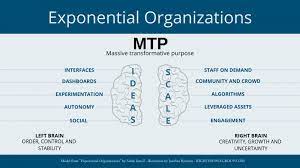
Salim Ismail, Mike Malone and Yuri van Geest developed and published the concept of Exponential Organisation, ExO, which has now become a powerful tool for innovative organisational business model.
There has been a marked paradigm shift from traditional economic factors of production are land, labour, capital, and entrepreneur. The advent of technological innovations and the internet-of-things have revolutionised every aspect of our daily lives. Businesses the world over, now leverage digital resources to achieve their goals. Such innovations include search engines, social media, Web3, metaverse, etc.
Organisations have now shifted their operations to cyberspace. There is a paradigm shift from brick-and-mortar offices and traditional markets to the virtual world. 21st-centuryst century companies now seek to assert their presence in the virtual world because of easy access; larger target audience; a large pool of data; cheap acquisition of resources; little or no regulation, censorship, or other forms of government control; the fast flow of information; inexpensive development and maintenance of a web presence.
Notable examples of ExOs include Uber, Airbnb, Netflix, Facebook, twitter, BlaBlaCar, Amazon, Tesla, WhatsApp, and Bitcoin. These companies have revolutionised the industries in which the operate. They are ten times faster, cheaper, and better than traditional entities due to their adoption of the ExO model.
MTP: Massive Transformative Purpose
This involves setting high-level-goals. The ExOs think big, plan big, set big goals different from conventional vision and mission statements. The key drive is to achieve a radical change and improvement. That ultimately leads to a better world.
SCALE – it provides for growth, creativity and uncertainty
- Staff on Demand - Reduce workforce to only essential staff. Use non-core staff as frequently as possible. Do not keep employees on payroll for anything. Engage employee service when there is an absolute need for his service. This reduces redundancy and bloated wage bill.
- Community & Crowd – Community willingly supporting the company, assume responsibility for tasks in furtherance of the company’s objective.
- Algorithms – This is the language of computer. In digital age, information and date is very key. Algorithms form the basis for interacting with this data and making it useful for people, including you and your customers.
- Leveraged Assets – Traditional accumulation of assets should be discouraged. Asset should either be borrowed and tasks outsourced whenever possible;
- Engagement – Data andinformation assist to grow business community and create positive feedback loops. The loyalty of your users is strengthened and innovative ideas are collected from the community.
IDEAS – order, control and stability
- Interfaces – Automated workflow assist to forward the outputs from SCALE to the right people, places and at the right time in the organisation.
- Dashboards – summarises information in a pictorial, diagrammatic form to facilitate the overview, analysis, review and control,
- Experimentation – Continuous development by trial testing new ideas and assumptions through experimentation.
- Autonomy – Work takes place in interdisciplinary, self-organized, highly motivated teams. Authority is decentralized, with considerable degree of freedom to decide how tasks should be achieved. This engenders innovation and initiatives,
- Social technologies – interactions and decision-making are simplified and made more immediate through digital technologies.
Conclusion
According to the protagonists, organisation must have at least four elements of the IDEAS and SCALE to be qualify as ExO. The principles, which is applicable to conventional companies, are: include as many already used assets as possible, avoid too much permanent staff, give your staff more responsibility, listen to your employees, provide your employees with as much information as possible, don’t be afraid of newcomers, take advantage of new technologies, and try out new ideas.




 Key Terms in Cost & Management Accounting
Good stuff