
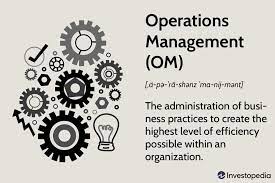
Today we shall be looking at some learnings from operations management. What actually does operations management entails. We shall seek to understand this and some more in this short piece.
We shall first endeavor to define what operations is all about, with its purpose and all the basic components; when we have this understanding, then we shall easily understand what operations management is about. Basically, we shall actually be talking about the management of operations.
Operations is one important process to culminates into the success of any serious institution or business entity. Coupled with marketing, operations are where a business entity adds value and basically makes money. Operations is actually seen as the engine and the driver of any and every successful organization. The goal of operations is to produce goods and services efficiently and effectively.
To further understand this concept of operations, let us look at the four basic aspects of all organizations:
- The purpose and components of operations.
- The key tasks that operations managers must manage for their respective organizations to do well.
- The type of operations systems and their management requirements.
- Some tools to help you diagnose and solve operations problems.
It is important for us to understand that operations surrounds us, it is actually everywhere and we experience its processes on a day to day basis. All the parts of every institution or business entity have operations component, which is most of the time critical to financial success. We see operations in our everyday settings such as banks, stores, hotels, restaurants, airlines, universities, etc.
We note here that some enterprises transform materials, others transform customers, and others transform information, even though almost every organization transforms a mixture of inputs, and one type usually dominates. As a way to illustrate, steel companies concentrate on transforming materials like iron ore, lime, and coal. Universities transform patients or students. Restaurants transform materials in the kitchen and customers in the dining room. Fashion mistresses transform sewing machines and clothes to stylish clothes.
Operations is indeed everywhere. Accounting departments need a process to transform transactions into financial records. Marketing departments need a process to capture information from customers. Personnel departments need processes to hire, train, evaluate, promote, motivate, discipline, and lay off staff.
Again, inputs and outputs are a matter of perspective; operations, which follow a due process is the key. For example, the iron mine’s output which is iron oxide concentrate, becomes a major input for the steel mill, which in turn churn out steel as output. These steels are then purchased by spare part manufactures who use them to produce body panels, wheels, engines etc., for sale to automobile assemblers. They sell their finished products to dealers who, in turn, sell them to consumers. It is actually a defined chain, and it explains what an operation is all about.
Furthermore, we want to note that operations add value. For example, banks buy money from depositors (by paying interest on deposits) and sell it to borrowers (by charging interest on loans). Real estate brokers are able to bring buyers and sellers together because they know the local market. Paper mills link forestry companies to newspapers because they can transform wood into paper.
To be continued.
Andrew Omeike
#MEMBA11




 Ease of Doing Business in Nigeria