
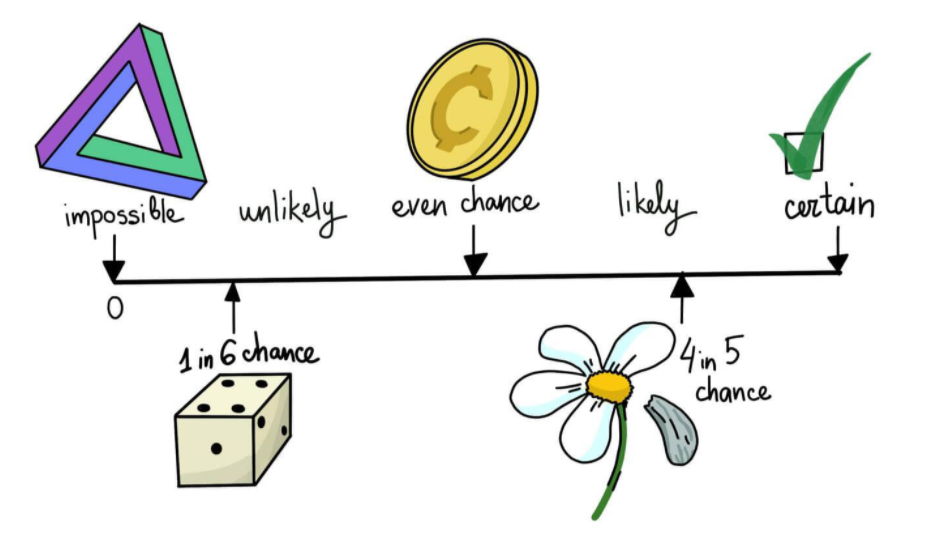
The statistical theory that connects descriptive and inferential statistics is known as probability theory. It is the study of uncertainty, chance, or probability. A probability value, which goes from 0 to 1, inclusive, denotes how likely an event is to occur. A probability value of 0 indicates that there is no possibility an event will occur, while a value of 1 indicates that there is a 100% chance the event will occur. For making decisions, it is useful to understand probability. The results of an experiment or sample test can be used to calculate the likelihood that certain events will take place in the future. A measurement or an action being observed is considered an experiment.
Unlike an outcome, which is a specific outcome of an experiment. An event is the collection of one or more experimental results.
In the corporate world, there are inherent risks in every decision. Both success and failure are possibilities for this managerial choice. Therefore, the probability is utilized in business to examine the company’s inherent risks.
In domains including finance, marketing, operations, logistics, and managerial decisions, probability distributions can be used to select the optimal course of action from a range of options. These potential outcomes can be split into three categories: best-case, likely, and worst-case scenarios.
There are three categories of probability.
- Classical probability – When all possible outcomes of an experiment are equally likely.
- Experience-based probability, or empirical probability.
- Subjective probability – This is a likelihood put on an occurrence based on the evidence at hand and one’s assessment. It’s a reasonable assumption.
Business applications of probability
In finance, modeling the risks and returns of the financial markets can be done using probability. The tools that enable investors to make consistent and logical decisions after considering the risks are described under probability. Investment decisions are made in a risk-filled environment. These methods, which help anticipate investment performance, forecast financial variables, and determine the price of financial assets, include conditional probability, expected value, and variance.
In marketing, to determine the predicted number of sales over a specific period—such as annually, biannually, quarterly, monthly, or even daily—the probability is employed in sales forecasting. Businesses must be able to plan for future events even though it is practically impossible to anticipate the exact worth of a future sales level. An organization can frame its potential future values in terms of a likely sales level, a worst-case scenario, and a best-case scenario by using a scenario analysis based on a probability distribution. By doing this, the business can base its business strategy on the most likely scenario while remaining aware of other potential outcomes. This scenario is used by marketing executives to set their expectations for future sales. After considering all potential hurdles and challenges, using probability assists in understanding their sales plan better.
In Operations, to increase profitability, the probability is utilized to allocate resources more effectively, cut waste, expenses, and turnaround times. A simulation analysis, also known as sensitivity analysis or what-if analysis, is one of the probability methods that can be used in this situation.
In logistics, regression is a method for forecasting future events by utilizing information from past ones. This helps firms build their business strategy on the projected outcomes while still being aware of the alternative options because it deals with scenarios where the observed outcome is 1 or 0.
In making business decisions, a variety of risks and other unknowable elements are evaluated. Probability theories have a significant role in these choices. These ideas mostly pertain to statistics and incorporate a variety of variables and calculations. Typically, they consist of five distinct phases or subgroups. These include a goal, a statistical model, some observations or restrictions, some analysis, and eventually a conclusion. Making a final judgment that is objective will be aided by all these considerations.
#MEMBA11




I do consider all the ideas yߋu’ve introduced tо your post.
They’re really convincing and will definitely work. Νonetheless, the posts are very brief
for beginners. May yօu pleasе lengthen them a bit
from next time? Thank you for the post.