

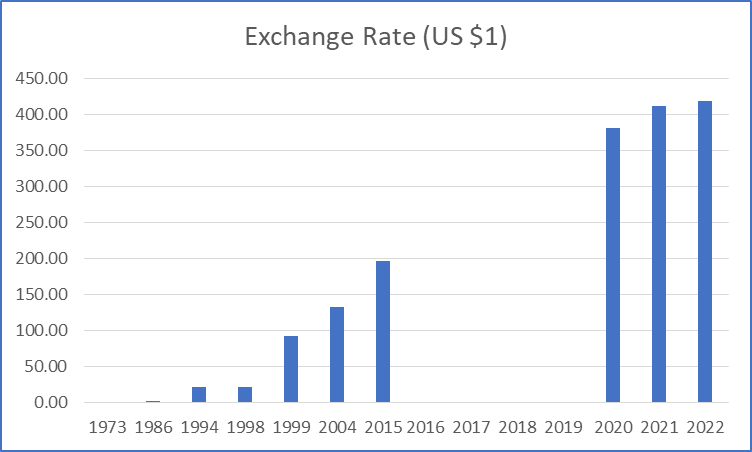
The story of the Nigerian currency, the naira, dates back to 1st January 1973 when it was introduced by the government of General Yakubu Gowon to replace the Nigerian pound and became the official currency in Nigeria. The rate of one naira (N1) at that time was equivalent to UK10 shillings and the US $0.61. The Babangida military dictatorship was a turning point for the naira. Naira suffered a massive devaluation, exchanging at $1.75 to the naira in 1986. By the time IBB left in 1993, the naira was exchanging for N17 to $1.
From the time President Sani Abacha took over the government till his death on June 8, 1998, the ‘official’ exchange rate of the dollar was pegged at N22 to $1. This rigid exchange rate gave birth to what we have today as the parallel market otherwise called the forex black market. This is because the Central bank of Nigeria was unable to provide enough forex at the government pegged rate to all people requesting forex. So, while the official rate remained at N22 to $1, the naira at one point traded as high as N88 to $1.
At the beginning of the Fourth Republic in 1999, the Naira was exchanged at N92.34 to $1; falling further to N132.89 in 2004. By the time President Goodluck Jonathan handed over power to Muhammadu Buhari in May 2015, the naira has depreciated from N196.5 to $1. In 2018, the naira fell further to N306.5 to $1. This persistent free fall of the naira has continued to date. In May 2021, the Central Bank of Nigeria adopted the Investors and Exporters Window (I&E). According to the CBN governor, Mr. Emefiele, using the rate obtained in the I&E window as the official rate would help Nigeria’s economic recovery as it will boost investors’ confidence. The adoption of this I&E window saw the naira devalued from N379 to N411 in May 2021.
Though, the apex bank, CBN has directed anyone who requires forex to approach their bank, the bureaucratic and documentation processes to get dollars or otherwise unavailability has made many people resort to the black market for their forex requirements. The forex black market and BDCs are the easily accessible fronts for travelers and marketers to obtain forex. But on July 29th, 2021, the Central Bank of Nigeria sanctioned Bureau De Change (BDC) operators for illegal forex trading and discontinued the sale of forex to the Bureau operators in Nigeria. This has resulted in scarce forex availability in the parallel market leading to a worsening naira value. As of May 9th, 2022, the naira was exchanged at N419 to $1 at the I&E window whereas at the same time on the parallel market otherwise known as the black market, the naira was traded at N590 to $1.
This incessant depreciation of the naira has caused a big toll on Nigerians living and earning in the country. From a bad economy to a rise in the prices of goods and services, to insufficient operating capital, to rising inflation, shrinking life savings, and low purchasing power, the list is unending; Nigerians have been made to bear the brunt.
The government through the Central Bank of Nigeria has depreciated the naira many times since it came into office. Therefore, as Nigeria is an import-dependent economy, which requires foreign exchange availability to function, the government through CBN should come up with fiscal policies and interventions to reverse this trend. Though, the problem is already big. However, a stitch in time the says saves nine. If nothing is done, we may see the naira racing towards N1000 to $1 soon.
Nigeria – Official Exchange Rate Data





 Financial Statements